

Your Face Is Prime Real Estate. Glasses Should Be Chosen Carefully.
Online eyewear conversion is stuck at 2-4%. How virtual try-on lets shoppers see glasses on their own face before they buy.

Your Face Is Prime Real Estate. Glasses Should Be Chosen Carefully.
Think about the last conversation you had. Where did your eyes go? The other person’s face. That’s where everyone looks. It’s instinct.
Now consider what that means for eyewear. Glasses sit directly in the center of where everyone’s attention lands. They frame your eyes. They affect how your nose reads. They interact with your eyebrows, your cheekbones, your whole facial geometry.
This is not the place for guesswork.
And yet online eyewear shopping asks customers to do exactly that. Pick frames from flat photos. Imagine how they might look. Hope for the best. The result? Online eyewear conversion rates sit at a stubborn 2-4%, and return rates can spike to 50% without proper fit solutions.
That’s why Antla is expanding into eyewear. Because what goes on your face deserves more than a product grid and a prayer.
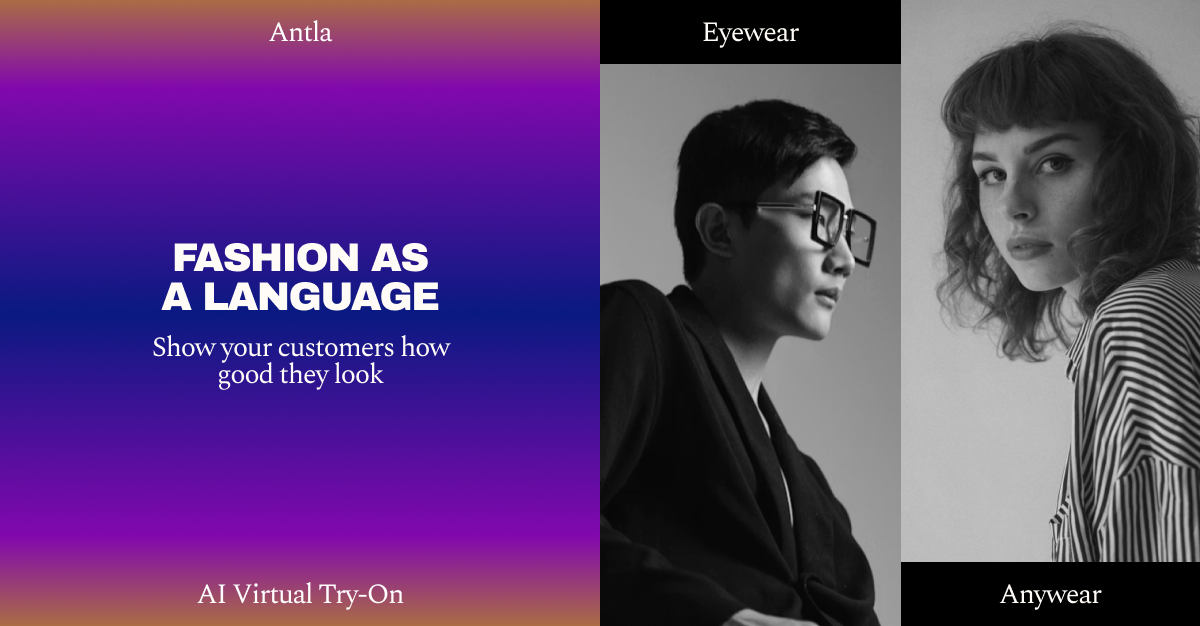
The Hundred-Pair Problem
Anyone who wears glasses knows the ritual. You walk into an optical shop, and you try on frames. A lot of frames. Twenty. Fifty. Sometimes a hundred before you find the one.
Each time you’re running the same mental calculations. Does this make my nose look too pronounced? Are my eyebrows sitting right above the frame? Does it balance with my face shape or fight against it? Am I pulling this off or just convincing myself?
This anxiety isn’t superficial. It’s rational. A bad frame doesn’t just look off. It becomes the first thing people notice when they meet you. It distracts from eye contact. It undermines the impression you’re trying to make. Glasses are permanent in a way that clothing isn’t. You don’t swap them out daily.
So customers are careful. They should be. But that carefulness translates to friction online.
According to Auglio research, 69% of consumers say they would feel more confident buying glasses online if they could try them virtually first. That confidence gap is costing eyewear brands conversions every day.
A $40 Billion Market With a Visualization Problem
The e-commerce eyewear market hit $39 billion in 2024 and is projected to reach $77 billion by 2035. Online channels are growing at 12% annually, faster than almost any other distribution method.
The demand is there. Customers want the convenience and pricing of buying glasses online. What they don’t want is the uncertainty.
Warby Parker built a $3 billion company partly on the home try-on model. Send five frames, try them at your kitchen table, send back the rejects. It works, but it’s slow and expensive for the brand. Shipping costs eat margins. Return logistics create friction. And customers still can’t see themselves in every frame you offer.
Virtual try-on solves what home try-on can’t. Immediate visualization. Unlimited frames. No shipping delays. According to Fittingbox research, eyewear retailers using virtual fitting tools see up to 28% reduction in returns and 22% lower cart abandonment.
The technology exists to let customers try on every frame in your catalog without leaving their couch. The question is whether you’re offering it.
What Antla Eyewear Actually Does
Antla’s eyewear try-on brings the same technology that’s driven 35% conversion lifts in fashion to the eyewear vertical.
Here’s how it works. A customer uploads a photo or uses their camera. Antla’s AI maps their facial geometry. Then every frame in your catalog becomes something they can see on their own face, not a model’s.
The psychological shift is immediate. They stop evaluating frames abstractly and start imagining themselves wearing them. That’s when browsing becomes buying.
For eyewear specifically, the face-mapping precision matters. Customers can see how frames sit relative to their nose bridge. They can gauge whether their eyebrows peek over the top of the frame. They can tell if the width matches their face or overwhelms it. The details that matter most in a mirror now show up on screen.
More Time, More Try-Ons, More Sales
When customers can try frames on themselves, they stay longer. They explore more. They build confidence with each visualization.
Studies show virtual try-on can double or triple conversion rates for eyewear compared to standard product pages. One reason: customers who engage with try-on are demonstrating real purchase intent. They’ve moved past casual browsing. They’re actively shopping.
That extended engagement cascades into other metrics. More page views per session. Higher email capture rates as customers want to save their favorites. Better data on which frames resonate with which customer segments.
And the compound effect matters. A customer who finds glasses they love through virtual try-on becomes a repeat buyer. Prescription updates. Sunglasses. A backup pair. The lifetime value of a confident eyewear customer is substantial.
Your Frames Deserve to Be Seen
You’ve curated beautiful eyewear. You’ve sourced frames that balance style and function. You’ve built a brand that customers want to wear on their face.
Don’t let that effort get lost in a grid of thumbnails.
The eyewear market is shifting online faster than almost any other fashion category. By 2034, digital channels are projected to account for 45% of global eyewear sales. The brands that capture that growth will be the ones that solve the visualization problem.
Virtual try-on isn’t just a feature. It’s the answer to the fundamental anxiety that keeps customers from buying glasses online: “Will these look right on my face?”
Give them a way to see for themselves. Then watch what happens to your conversion rates.
Getting Started With Antla Eyewear
1. Start with your bestsellers. Enable try-on for your top-performing frames first. These are the products with proven demand. Removing the visualization barrier will have the clearest impact.
2. Promote the feature prominently. Don’t bury try-on in a submenu. Make it a central part of the product page experience. Customers can’t use what they don’t notice.
3. Track engagement and iterate. Watch which frames get tried on most. Use that data to inform merchandising, marketing, and buying decisions.
The Face Is Where Attention Lives
Glasses aren’t like jackets or shoes. They sit at the center of every human interaction. They shape how people perceive you. Choosing a pair is a decision that carries weight.
Your customers know this. That’s why they try on a hundred frames in person. That’s why they hesitate to click “add to cart” online.
Antla eyewear gives them permission to trust the screen. To see themselves in frames they love. To buy with the same confidence they’d feel walking out of an optical shop.
The technology is here. The market is ready. Your frames are waiting to be tried on.
Frequently Asked Questions
What is virtual try-on for glasses?
Virtual try-on for glasses is AI-powered technology that lets customers see eyewear frames on their own face before purchasing online. Instead of imagining how frames might look, customers upload a photo or use their camera and see realistic visualizations of any frame in the catalog on their actual facial features.
Does virtual try-on work for prescription glasses?
Yes. Antla’s eyewear try-on works for all frame types including prescription glasses, sunglasses, and blue light glasses. The technology focuses on visualizing how frames look on the customer’s face, independent of lens type.
How accurate is virtual try-on for eyewear?
Antla uses AI-powered facial mapping to position frames accurately based on the customer’s actual facial geometry. Customers can see how frames align with their nose bridge, brow line, and face width, giving them a realistic preview before purchase.
Can virtual try-on reduce eyewear returns?
Yes. Studies show eyewear retailers using virtual fitting tools see up to 28% reduction in returns. When customers can visualize frames on their own face before buying, they make more confident purchase decisions and are less likely to return products due to fit or style issues.
How much can virtual try-on increase eyewear conversion rates?
Research shows virtual try-on can increase eyewear conversion rates by 18% to 90% depending on implementation. Some eyewear retailers report 2x to 3x higher conversion rates for customers who engage with virtual try-on compared to those who browse product photos alone.
How long does it take to set up Antla eyewear try-on on Shopify?
Antla integrates directly with Shopify stores without requiring code. Most merchants can enable try-on for their eyewear catalog within minutes and start seeing engagement immediately. The app works with all Shopify themes.
What types of eyewear does Antla support?
Antla supports a full range of eyewear including optical frames, sunglasses, reading glasses, and fashion eyewear. The technology adapts to different frame shapes, sizes, and styles to provide accurate visualization for each product in your catalog.
Why do customers hesitate to buy glasses online?
The primary barrier is visualization uncertainty. Glasses sit on the face, the center of human attention, making fit and style critically important. Customers worry about how frames will interact with their nose, eyebrows, and face shape. Without the ability to try frames on, many abandon their carts or over-order to return what doesn’t work.
How does Antla eyewear try-on compare to home try-on programs?
Home try-on programs like Warby Parker’s require shipping physical frames, limiting customers to 4-5 options per shipment. Virtual try-on allows customers to see unlimited frames instantly with no shipping delays or logistics costs. Both approaches solve the visualization problem, but virtual try-on scales better and provides immediate results.
What is the eyewear ecommerce market size?
The e-commerce eyewear market reached approximately $39-55 billion in 2024 and is projected to grow to $77-97 billion by 2035. Online channels are growing at 12% annually, with digital sales expected to account for 45% of global eyewear sales by 2034.