

Event Fuel for a Remarketing Engine
Browse, try-on, and cart are not equal fuel. How Shopify fashion stores rank events so a remarketing engine spends attention on product-level intent.

A merchandiser sees three shoppers beside the same linen dress. One passed through the collection page. One generated a virtual try-on and compared two colors. One added the dress to cart, then left when shipping appeared. The analytics dashboard calls all three “engaged.”
That label is tidy and commercially unhelpful.
The best fuel for a Shopify remarketing engine is a recent event that names the product, records meaningful shopper effort, and preserves the decision context. For fashion stores, a completed virtual try-on usually carries more intent than a product view because it shows self-referenced evaluation. Cart is stronger purchase progression, but it should not automatically erase the fit and appearance evidence inside the try-on.
The job is to rank signals without flattening them. A good engine spends more attention on an inspected garment than on a loaded page, and it remembers why the shopper hesitated.
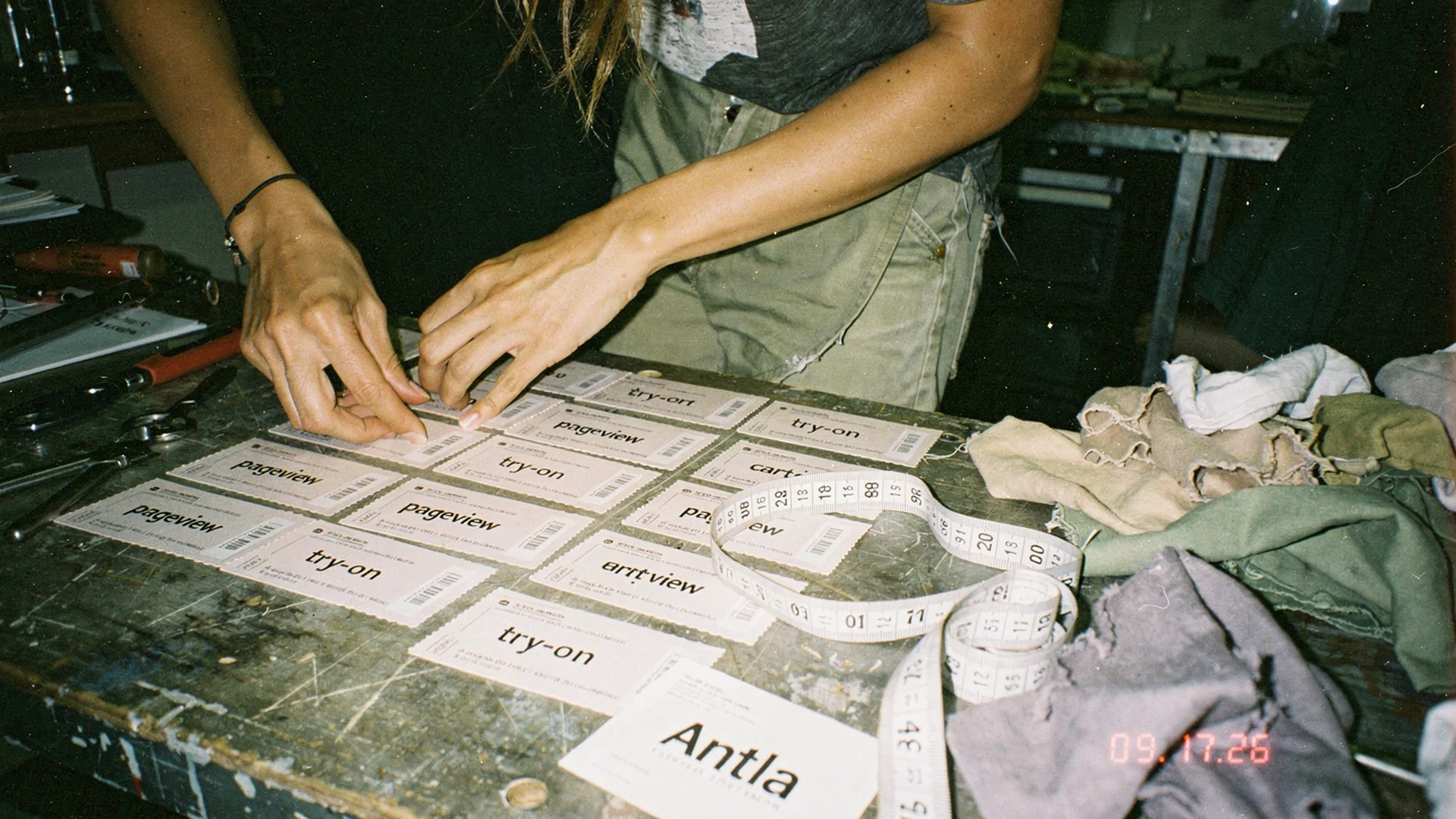
Browse, try-on, and cart describe different stages of a fashion decision. The engine should preserve the strongest useful context. Editorial image in Classic Antla disposable-camera style.
Grade events by the decision they reveal
Event volume is easy to admire. Fuel quality is harder because it asks the team to decide what each action actually proves.
A homepage view proves arrival. A collection view adds a category, perhaps “occasion dresses,” but not a serious product decision. A PDP view names a garment. Repeated views add persistence. Fit-detail use, variant changes, virtual try-on, cart, and checkout each expose a different piece of the decision.
Use four questions when grading an event:
- Specificity: Does it name a product or variant, or only a page and category?
- Effort: Did the shopper actively evaluate something, or did the browser merely load it?
- Recency: Is the decision still live for this product, season, and inventory state?
- Recoverability: Did the event retain enough context to create a useful next action?
That last question separates an interesting metric from usable fuel. product_viewed with a product ID can restore the garment. high_intent_user with no SKU, variant, timestamp, or source action leaves the creative team staring at a confident label and an empty brief.
Shopify’s guide to product detail pages treats the PDP as the place where images, descriptions, variants, reviews, and purchase details support evaluation. Your event model should preserve which part of that evaluation the shopper used. A size-guide open on tailored trousers means something different from a color switch on a loose cotton tee.
A practical fuel quality table for fashion
The ranking below is a starting hierarchy, not a universal prediction model. Validate it against your own comparable cohorts by product family, device, traffic source, and customer type.
| Shopify event | Product specificity | Shopper effort | Fuel quality | Merchandising use |
|---|---|---|---|---|
| Homepage or collection view | Low | Low | Weak | Category discovery only, usually too broad for paid follow-up alone |
| Single product view | Medium | Low | Limited | Restore the exact PDP, but avoid treating one load as settled interest |
| Repeated product view | High | Medium | Useful | Highlight the same garment, recent variant, and unresolved product facts |
| Size guide, fit detail, or variant comparison | High | Medium | Strong | Answer rise, inseam, stretch, coverage, color, or size availability |
| Completed virtual try-on | High | High | Very strong | Continue a self-referenced appearance and fit decision |
| Add to cart | High | High | Very strong | Resolve price, delivery, stock, payment, or remaining product uncertainty |
| Checkout started | High | High | Highest purchase progression | Remove transaction friction and suppress immediately after purchase |
| Purchase | Exact | Complete | Exclusion | End recovery for the purchased item and update cross-sell eligibility |
The table contains an important distinction. “Higher” does not mean “replace everything below it.” Checkout progression tells the engine that the shopper moved closer to payment. A prior fit event may still explain what she was deciding.
A shopper can add a blazer to cart after trying it on, then abandon because sleeve length remains uncertain. If the cart event overwrites the try-on and size-guide history, the next message may offer a discount when the useful answer was the sleeve measurement.
Why a completed try-on beats a pageview
A product view is cheap for the shopper. It can result from a search click, a wrong tap, or a tab left open while the kettle receives more attention than the knitwear.
A completed try-on requires a sequence: choose the garment, provide or reuse a photo, wait for a generation, and inspect the result. The shopper has moved from seeing the item on a model to evaluating it in relation to herself. That is product-level intent with appearance context.
Baymard’s apparel and accessories research documents more than 500 apparel-specific UX guidelines around imagery, fit, sizing, product information, and returns. That breadth is the point. Fashion shoppers are not deciding whether a generic object is acceptable. They are judging shoulder placement, waist behavior, drape, transparency, length, and how a color works near their face.
Shopify’s virtual fitting room overview frames the technology around confidence and reduced purchase uncertainty. For remarketing, the completed preview also creates a precise record: this shopper actively evaluated this product at this time.
Across more than 500,000 Antla try-ons, shoppers who completed a preview converted at 3.8%. That is the conversion rate among try-on users, not a store-wide benchmark and not proof that every generation predicts a sale. It does show why completed try-on deserves its own cohort instead of being hidden inside “all product visitors.”
The virtual try-on feature can provide that richer event while the product page still supplies essential truth. A preview does not replace garment measurements, model dimensions, fabric composition, fit notes, or varied photography. It tells the engine that a shopper used personal visualization as part of the decision.
Let cart advance priority without deleting context
Cart and try-on events answer different questions. Cart says, “this product entered a purchase path.” Try-on says, “this shopper evaluated how this product may look on her.” The engine needs both facts.
Use an event precedence rule with memory:
- Increase urgency when progression advances. Cart and checkout can shorten the response window.
- Carry forward useful attributes. Keep the tried product, selected color, size interaction, and latest fit detail attached to the active decision.
- Suppress on the actual outcome. Purchase overrides recovery. Consent withdrawal, unavailable inventory, and an expired decision also end eligibility.
- Replace stale product focus carefully. A newer try-on for a different dress may become the primary signal, while the old cart should not keep winning forever.
- Deduplicate channel pressure. One strong decision can feed email, SMS, and ads, but it should not create three teams independently pressing Send.
This is why event ranking belongs inside a remarketing engine, not inside each destination. The engine decides which product decision is active before delivery tools compete for it.
If the infrastructure is still being assembled, build the Shopify remarketing engine with event names, identity, permissions, suppression, and expiry defined together. Then connect Klaviyo, SMS, and ads to the same ranked payload rather than recreating intent separately in each platform.
Give the winning signal a complete payload
Merchandisers do not need every click. They need enough truth to continue the product decision without inventing it.
For each qualifying event, retain:
- event name and completion status
- event timestamp and expiry
- product and variant IDs
- selected size, color, or compared variants when available
- prior stronger context, such as a completed try-on
- session or customer reference
- channel permission state
- inventory and product availability
- purchase state and suppression time
Keep generated shopper images private. The engine can use the fact that a try-on happened and the product involved without sending the personal image into a public ad audience. Returning an image privately to the same shopper requires appropriate notice, consent, access controls, and retention rules for that use.
The campaign mechanics in Shopify remarketing from virtual try-on show how the signal becomes a product-specific audience and hesitation-led message. The event-fuel decision comes first. Bad fuel distributed efficiently is still bad fuel.
Questions merchandisers ask
What events should fuel a remarketing engine?
Use recent events that retain a product reference and reveal meaningful decision effort. Repeated PDP views, fit-detail use, variant comparison, completed virtual try-on, cart, and checkout can qualify at different levels. Rank them by specificity, effort, recency, and recoverability. Treat purchase as an exclusion event, not another recovery trigger.
Is virtual try-on better fuel than a product view?
Usually, yes. A completed virtual try-on requires active, self-referenced evaluation of a specific garment, while a single product view only confirms that the page loaded. Try-on should therefore receive a higher intent score, while the PDP remains the source for measurements, fabric, fit notes, imagery, and product terms.
Should cart events override try-on events?
Cart should increase purchase priority, but it should not erase try-on context. Preserve the product, variant, fit interactions, and preview completion as attributes of the active decision. Purchase, consent withdrawal, unavailable stock, or expiry should override recovery eligibility completely.
Start with one rack, not the whole catalog
Choose one product family where appearance uncertainty is visible, such as structured blazers, occasion dresses, or wide-leg trousers. Rank its events, inspect ten real journeys, and check whether the winning signal leaves a merchandiser enough context to write a useful response.
About the author: Aaron founded Antla and thinks a completed try-on is worth more than ten collection-page views, even if ads platforms treat them as cousins.
If your current remarketing audience knows that a page loaded but not which fit decision happened, add Antla to your Shopify store and give the engine product-level fuel.