
Conversion Engine vs CRO vs Personalization
CRO tests pages. Personalization needs history. A conversion engine captures intent on visit one and recovers it later. How fashion merchants should choose.

An agency audit finds a testing platform, a recommendation app, and six welcome-popup variants. The merchant calls the stack personalized. A first-time shopper opens a structured blazer, wonders whether the shoulder will sit correctly on her, and receives a carousel of other blazers.
The software did what it was configured to do. The shopper’s question survived untouched.
A conversion engine is a system that captures a product-intent event, helps resolve it in the current visit, and keeps the unfinished decision available for recovery. CRO tools improve paths for groups. Personalization changes what an individual sees from context or history. Fashion stores may need all three, but they are not substitutes.
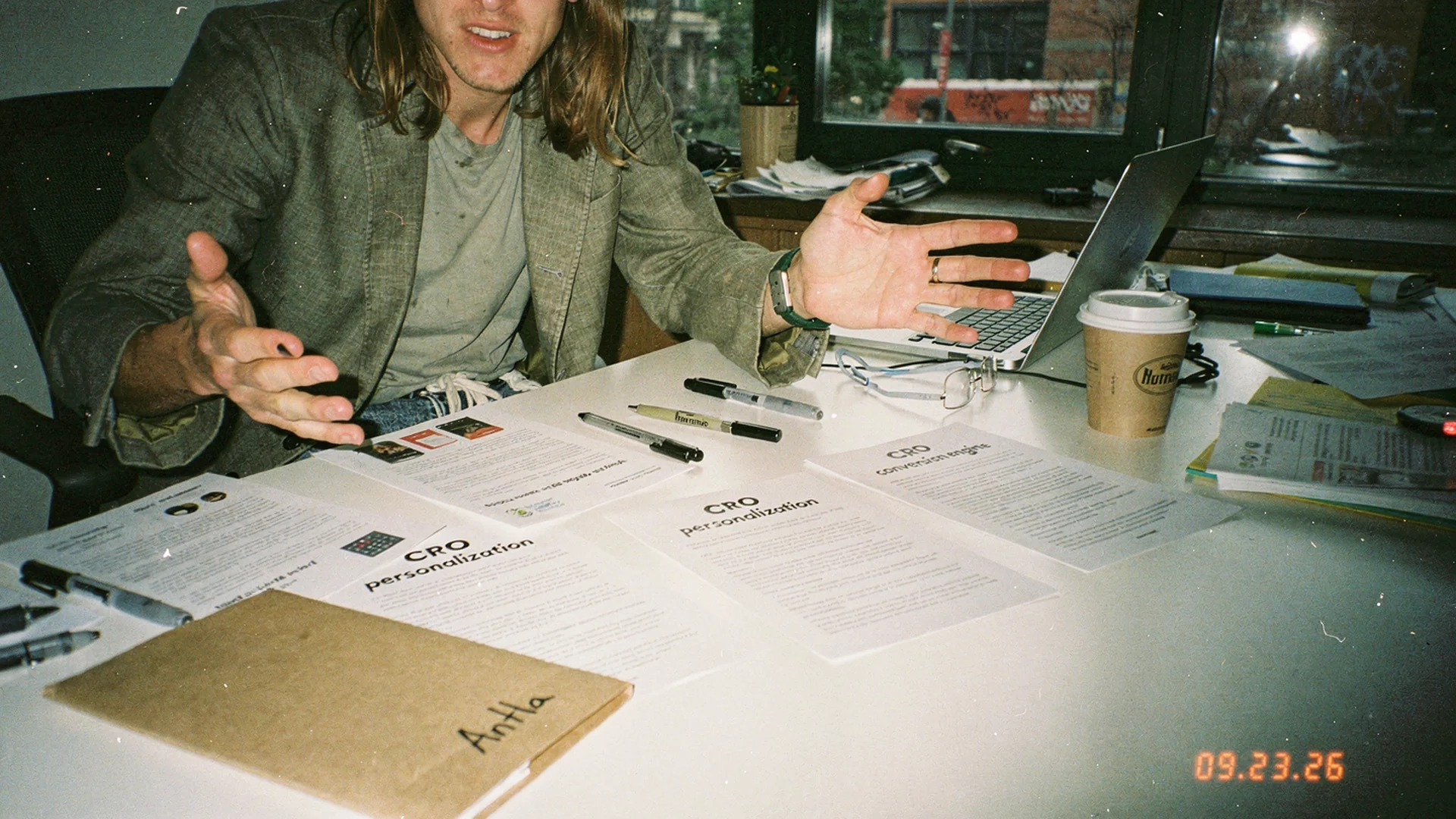
CRO improves the path, personalization selects an experience, and a conversion engine carries a product decision from the first visit into recovery. Editorial image in Classic Antla disposable-camera style.
Start by separating the jobs
These categories can each influence conversion. They are not interchangeable.
The practical distinction is the unit each system acts on:
| System | Primary job | Data needed | What it can do on visit one |
|---|---|---|---|
| CRO tools | Find and reduce friction across a page or funnel | Aggregate behavior, experiment exposure, and outcomes from comparable visitors | Enroll a new visitor in a test and measure the cohort, but usually not answer her individual product question |
| Personalization | Select content, products, or offers for an individual | Context such as source, device, or location, plus session or customer history for deeper relevance | Make contextual choices immediately; behavioral recommendations are limited until the shopper creates history |
| Conversion engine | Turn a specific intent event into an order now or a recoverable decision later | Product action, selected item or variant, timestamp, outcome, and identity or consent when follow-up requires it | Capture deliberate intent, resolve uncertainty in the session, and retain enough context to continue after exit |
The full definition of a conversion engine covers its two connected loops. The important agency decision is narrower: decide whether the brief asks for population learning, individual selection, or completion of a live product decision.
CRO tells you which experience wins
CRO tools are built to compare. They test product-page layouts, image order, copy, calls to action, delivery messages, checkout steps, and other friction points. A first-time visitor can enter an experiment with no known profile because the system learns from many comparable sessions.
That is valuable, especially when the store has enough traffic to reach a readable result. If moving delivery information above the fold improves completed checkouts, the winning experience can help future visitors before the brand knows anything about them.
But an A/B test is not a memory of one shopper’s decision. It can show that a new size-guide treatment increased use across the test population. It does not automatically remember that Priya inspected the rise and inseam of one pair of trousers, left, and should return to that exact context.
Shopify’s ecommerce optimization guidance frames conversion improvement across the complete customer journey. That is a useful boundary for CRO work. Fix slow mobile interactions, unclear returns language, weak photography, variant confusion, and checkout surprises. A conversion engine should not be hired to compensate for a product page that withholds basic facts.
Use CRO when the question sounds like this:
- Which product-page treatment reduces uncertainty for the eligible audience?
- Does a fit prompt near the image gallery outperform one below the description?
- Are shoppers abandoning because delivery and returns appear too late?
- Which change creates an incremental lift against a valid control?
CRO improves the road. It does not necessarily remember where one driver was going.
Personalization chooses from what it knows
Personalization is often described too broadly. Changing a homepage by campaign source is personalization. So is ranking products from a customer’s purchase history. The first needs context available at arrival. The second needs first-party history.
This is why the claim that personalization always requires history is too absolute. A store can adapt language, merchandising, or currency on visit one using geography, referrer, device, or an in-session action. It just has less evidence. Deep behavioral personalization becomes more credible after the shopper has viewed, compared, saved, tried, or bought something.
History also needs interpretation. A customer who bought a black dress six months ago may like black dresses, may have attended one funeral, or may share the account with her sister. More data does not remove ambiguity by itself.
Fashion recommendations commonly answer, “What else might this person like?” That is useful for discovery and basket expansion. It is a different question from, “What would help her decide whether this sleeve, drape, or shoulder line works on her?”
Shopify’s virtual shopping overview treats interactive shopping as a way to guide decisions and collect usable engagement signals. For an agency, that points to a better sequence: create a valuable interaction first, then use the resulting signal to improve later personalization. Do not demand a long customer history before the store becomes helpful.
A conversion engine makes visit-one intent usable
A conversion engine starts with a deliberate action. On a fashion product page, that might be a completed virtual try-on for a specific blazer and color. The interaction can answer an immediate visual question, while the event records what the shopper actively evaluated.
That visit-one capability is the key difference. The store does not need to infer interest from last season’s purchases. The shopper declares current intent by doing something now.
The engine then watches the outcome:
- The shopper opens a product and completes a high-intent action.
- The on-site layer returns useful decision support, such as a personal try-on.
- A purchase closes the loop.
- If no order follows, the event keeps the product, variant, time, and purchase state.
- When identity and channel consent permit, the store can restore that exact decision through email, SMS, an eligible ad audience, or a later on-site session.
- Purchase, consent withdrawal, unavailable stock, or expired intent stops recovery.
The virtual try-on conversion-engine layer explains the on-site half in detail. The larger system also needs recovery and suppression. Without those, the interaction is a useful feature that disappears when the tab closes.
Across more than 500,000 Antla try-ons, shoppers who completed a preview converted at 3.8%. That is a try-on-user conversion rate, not a store-wide rate and not proof that every preview caused a sale. It is useful because it identifies a behavior worth evaluating separately from a pageview.
This is the role of the Antla conversion engine: connect a fashion shopper’s try-on intent with an in-session decision and the destinations that can act when no purchase follows.
Choose the first install by locating the missing capability
The usual stack review starts with vendor logos. Start with the failure instead.
Choose CRO first when the buying path is visibly broken. Mobile selectors fail, product information is thin, pages are slow, or checkout creates surprises. Run controlled improvements before adding sophisticated routing to a weak experience.
Choose personalization first when discovery is the bottleneck. A large catalog may need better ranking, category adaptation, replenishment prompts, or customer-specific merchandising. Confirm that the store has enough trustworthy context to improve the selection.
Choose a conversion engine first when visit-one product intent is being wasted. Shoppers engage deeply with fit, appearance, variants, or try-on, yet the store records only sessions and orders. The missing capability is a bridge between active evaluation and later recovery.
For a high-traffic or complex storefront, the Shopify Plus conversion-engine guide covers event governance, theme rollout, and the need to keep cohort definitions stable across markets.
Before signing another annual contract, ask five questions:
- What exact shopper job will this system complete?
- Can it create value for an unknown first-time visitor?
- Which event proves the shopper used that value?
- Does the product and variant survive after the session?
- Can a later purchase suppress every related message quickly?
If the answer to the first question is “increase conversion,” the category work is not finished. That is the business outcome, not the system’s job.
Let the three systems work in sequence
The strongest setup gives each category a clean responsibility. CRO tests where and how the try-on entry point appears. The conversion engine helps the shopper evaluate the garment and records the unresolved decision. Personalization uses current context and later history to choose the most relevant experience when she returns.
Measurement should keep those responsibilities separate. Judge CRO by incremental lift between valid test groups. Judge personalization by improvement against a non-personalized or simpler decision rule. Judge the conversion engine by on-site use, try-on-user conversion, qualified non-buyers, suppression health, and recovered incremental revenue.
Shopify’s conversion-rate guide notes that category, price, device, traffic source, and purchase behavior change benchmarks. Compare like cohorts inside the store before using an industry number as a verdict.
An agency strategist should be able to draw the handoff on one page: test, intent event, immediate value, unresolved state, eligible recovery, purchase suppression. If three tools claim the same box, the stack is probably paying for vocabulary.
Questions fashion merchants ask
What is the difference between a conversion engine and CRO?
CRO finds changes that improve a page or funnel for groups of visitors, usually through research and controlled experiments. A conversion engine acts on a meaningful shopper-intent event. It helps convert that decision during the session, then preserves the product context so eligible non-buyers can resume it later.
Does personalization require first-party history?
Not always. Contextual personalization can use visit-one information such as location, referral source, device, or current-session behavior. Deeper behavioral personalization usually needs first-party history, such as prior views, try-ons, saved products, or purchases. A conversion engine can create useful history by capturing deliberate intent during the first visit.
Which should a Shopify fashion store install first?
Install against the clearest missing job. Use CRO tools first when the page or checkout path is broken. Use personalization first when product discovery and ranking are the main constraint. Use a conversion engine first when shoppers show product-specific intent on visit one but the store cannot resolve or recover that decision. Many mature stores need all three in that sequence.
Give each tool one honest job
The blazer shopper did not need another label in the app budget. She needed an answer about herself in the garment, then a sensible way back if she left.
Map that job before choosing software. Improve the path with CRO, choose relevant experiences with personalization, and use a conversion engine when current intent needs to become an order or a recoverable decision.
About the author: Aaron is the founder of Antla. He has watched stores buy three apps that all claimed to be personalization and none of them answered “on me.”
If visit-one apparel intent currently disappears at exit, add Antla to your Shopify store and give that decision a second route to revenue.