

How to Use Personalization in Fashion Email Marketing
Rank fashion email personalization tactics by effort against payoff, from merge tokens to generated try-on imagery, so you build the rungs that actually pay.

Every retention roadmap has the same slide. Someone has written “personalization” on it, and underneath sit eleven ideas with no order, no cost, and no argument about which of them is worth a development ticket.
That is the actual problem. The useful question is which version you should fund with the data and hours you have. A first-name token takes minutes. A product block needs reliable profile history. A generated try-on image needs a shopper preview. Calling all three “personalization” hides the decision.
For fashion email personalization, keep merge tokens as basic formatting, fix list segmentation first, add behavioral triggers next, and delay dynamic product blocks until profiles have enough history. Generated try-on imagery is the highest-effort rung, but it gives the shopper something no lower rung can: a view of the garment on her own body.
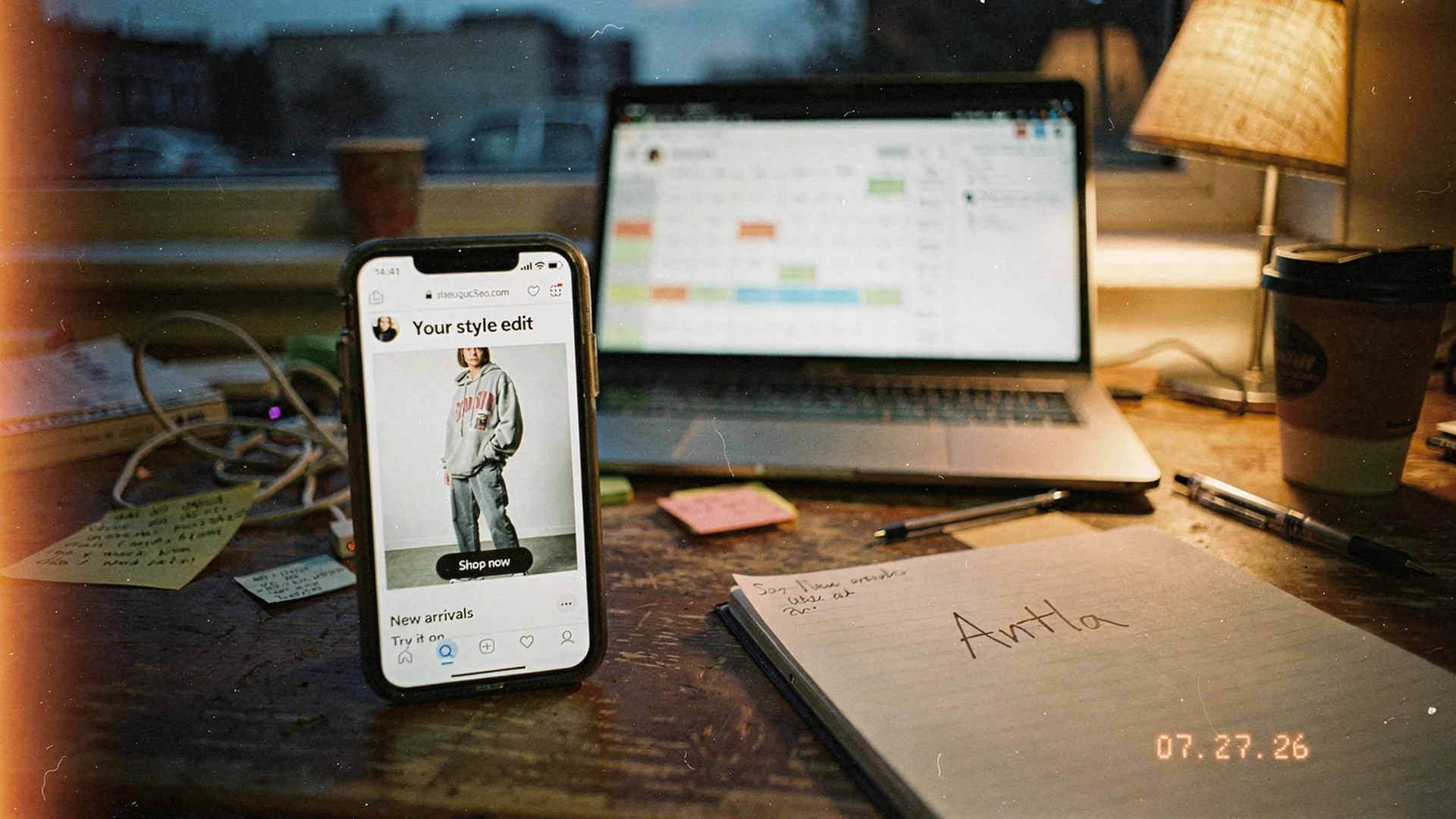
Personalization is a ladder, not a switch. The cheap rungs are cheap for a reason. Editorial image in disposable-camera style, inspired by Antla merchants who plan retention with a pencil before a platform.
Most personalized fashion email is a first name on a stranger’s body
Open the last campaign you sent. If the subject line carried a first name and the hero was the same studio shot from the collection page, the email was addressed to the shopper and about somebody else.
That distinction decides the payoff. Addressing is cheap and shallow. Relevance costs more and pays more. Klaviyo’s ecommerce benchmark report shows apparel click rates clustering in a narrow band for broadcast sends and running materially higher for triggered, behavior-aware flows. The gap between those two numbers is roughly the gap between the bottom of this ladder and the top.
The ladder, rung by rung
Rung one: merge tokens
First name, last purchase, loyalty tier. The configuration is light, and the effect wears off the moment a shopper notices every brand does it. Keep it, because it costs little to keep. Do not put it on a roadmap and call it a personalization project.
Rung two: list segmentation
Split by gender, category affinity, purchase recency, or price band. This is the first rung where a shopper notices something, mostly through absence: menswear buyers stop receiving dress launches. Segmentation is unglamorous, cheap, and the rung most fashion brands under-invest in relative to its return.
Rung three: behavioral triggers
Browse abandonment, cart recovery, back in stock, post-purchase. These messages respond to an action rather than a broad calendar slot. That makes them more relevant without asking the creative team to produce a separate campaign for every recipient.
Rung four: dynamic product blocks
Recommended styles rendered per profile, populated from browse and purchase history. Real engineering, real data dependency, and a well-known failure mode: the block recommends the jacket the shopper already bought, or falls back to bestsellers for anyone without history, which on most fashion lists is a large share of profiles.
Rung five: generated try-on imagery
The hero shows the shopper wearing the garment rather than a model wearing it. This rung is the only one where the creative itself is unique per recipient, which is why it behaves differently from everything below it. It also has a prerequisite the other rungs do not: shoppers have to be generating previews on your site first.
Build cost against expected payoff
| Rung | What it needs | Build effort | Realistic ceiling |
|---|---|---|---|
| Merge tokens | Profile fields you already collect | Minimal | Marginal, table stakes |
| List segmentation | Clean category and purchase data | Low | Solid, mostly from suppression |
| Behavioral triggers | Site events available to your ESP | Moderate | Strong relevance for recent actions |
| Dynamic product blocks | History per profile, recommendation logic | High | Good for repeat buyers, weak for cold profiles |
| Try-on imagery | A try-on app live on the PDP | Moderate after PDP setup | Strongest creative differentiation |
The pattern that matters: the first two rungs make an email less irrelevant, the last two make it specific. Those are different economic outcomes, and most roadmaps confuse them.
The rung to skip, and the one to stop polishing
Skip dynamic product blocks if the majority of your list has no purchase history. A recommendation engine with nothing to recommend from falls back to bestsellers, which is a newsletter with extra infrastructure. Come back to it when repeat purchase rate justifies the build.
Stop polishing merge tokens. The token has done its job once it resolves correctly and avoids awkward fallbacks. Litmus benchmark research is more useful for judging the health of the channel than another round of salutation changes. Litmus client data also makes the practical constraint plain: the garment image, copy, and fallback all need to work on a small screen.
The honest ceiling on the lower rungs
Segmentation and triggers make sure the right shopper sees the right garment at the right moment. Neither answers the question that stalls apparel purchases, which is whether the garment will look right on her.
That question is a visualization gap, not a targeting gap. You can route a midi dress to exactly the right segment at exactly the right hour and still lose the sale to the same hesitation the product page failed to resolve. Shopify’s guidance on ecommerce optimization makes the same point from the other direction: campaign work inherits whatever the landing experience leaves unresolved. This is where lower-rung optimization runs out of room, and it is why the top rung reads as a different category of tactic rather than a better version of the same one.
Why the top rung earns a separate budget
When the hero image shows the shopper in the garment, the email stops arguing and starts demonstrating. On Antla stores the return-rate delta reaches as much as 30% where appearance mismatch, rather than quality, was driving the refunds. On some women’s product pages, conversion among try-on users roughly doubles against shoppers who never open a preview.
The reason it works in the inbox is the same reason it works on the PDP. Antla’s virtual try-on generates previews from your existing product images, and the sessions it produces become both the creative and the segment. The shopper who previewed a coat and left is a specific person to email, holding a specific image.
Two caveats keep this honest. You need try-on volume on site before there is imagery to send, and you need consent and image-handling policy settled before anything personal enters a template.
Choose the stopping point before choosing the software
A small list with patchy category data should stop at segmentation until the inputs are clean. Adding recommendation logic to unreliable profiles creates a more elaborate way to show the wrong jacket.
A store with reliable browse and purchase events can justify behavioral triggers. If repeat buyers make up a meaningful part of the list, dynamic product blocks may earn the engineering time. Check the fallback rate first. A block that defaults to bestsellers for most recipients has not crossed the personalization threshold.
Try-on imagery belongs in the budget when shoppers already generate previews on the PDP and the team can handle consent, storage, and creative fallback. That is a higher bar, but it produces an asset tied to one shopper and one garment. No merge field can imitate it.
Once you choose the rung, hand the implementation to the right guide. Virtual try-on email personalization for Shopify covers the template and data layers, Klaviyo virtual try-on flows for fashion covers the platform work, and product images versus try-on imagery on click-through owns measurement.
Questions merchants ask before funding a rung
Which personalization tactic pays back fastest on a small fashion list?
Segmentation, then behavioral triggers. Both use data you already hold, neither needs engineering time, and both cut the irrelevant sends that drive unsubscribes on small lists. Save recommendation infrastructure for when repeat purchase volume can support it.
Are first-name subject lines still worth using?
Worth keeping, not worth testing. The setup cost is trivial so there is no reason to remove it, but treat it as formatting rather than personalization. The measurable movement in fashion email comes from what the message shows and when it arrives.
How much customer history do dynamic product blocks need?
Enough that most of the segment receiving them has meaningful browse or purchase history. If the majority of profiles fall back to bestsellers, the block is a newsletter with extra complexity. Check the fallback rate before approving the build.
What has to be in place before I can send try-on imagery?
A try-on app running on your product pages, enough session volume to generate previews worth sending, and a clear policy covering consent and image storage. Without live try-on activity, there is no personalized creative to render.
Reading for the rung you choose
- Shopify fashion growth use cases for the wider map of jobs this tactic sits inside
- Re-engaging shoppers who were interested in your brand for the intent signal behind the higher rungs
- Improving abandoned cart email click-through for where the click should land once the creative is right
About the author: Aaron is the founder of Antla, the virtual try-on app built for Shopify fashion brands. He spends most of his time on the gap between what a shopper is promised in an email and what they see when they land. He rates retention tactics by what they cost to build before he rates them by what they look like.
You do not need eleven personalization ideas. You need the two cheap rungs done properly and one expensive rung worth climbing. If preview imagery is the rung you want, install Antla on Shopify, let try-on volume build on your busiest category, and start with the flow where intent is already highest.