

Product Photography vs AI Virtual Try-On for Shopify Fashion
Product photography and AI virtual try-on solve different Shopify fashion PDP problems. Learn when to use each, how they work together, and what to measure.

Product photography and AI virtual try-on are often treated like competitors. They are not.
Photography answers, “What is the product?” Virtual try-on answers, “How might this product look on me?” A fashion PDP needs both questions handled well. One without the other leaves the shopper doing mental gymnastics, and most customers did not come to your store for a workout.
The better question is not which tool matters more. It is what each tool is responsible for.
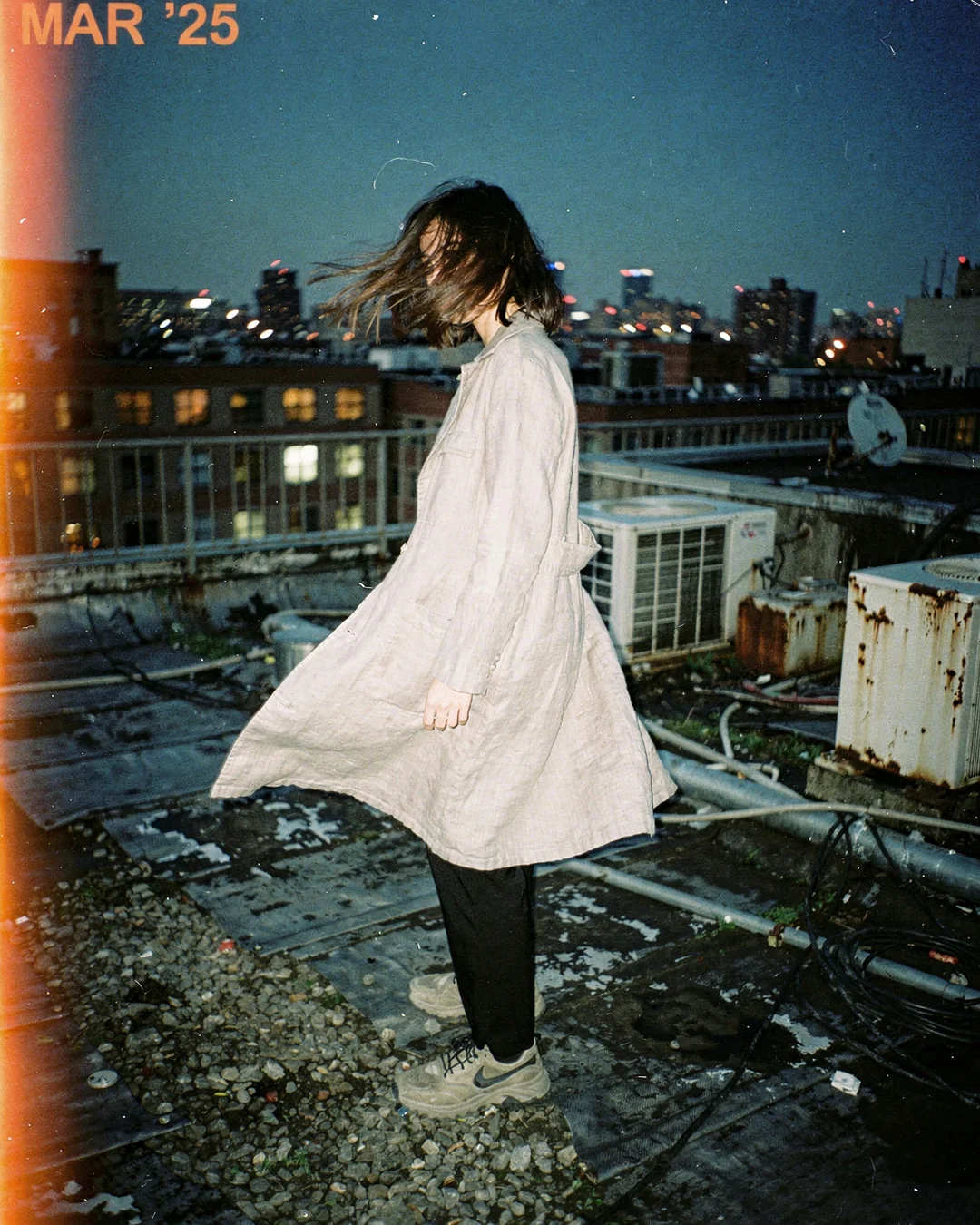
Photography establishes product truth. Virtual try-on adds personal relevance. Rooftop editorial from the Antla aesthetic library.
Photography Establishes Product Truth
Strong photography is still foundational. It shows material, color, construction, detail, scale, and styling. It gives the shopper evidence that the product exists in the world, not just in a render pipeline.
Shopify’s product detail page guide makes the basic PDP point clearly: media, details, reviews, and purchase information work together. For fashion, the media set needs to do more than look good. It needs to explain the garment.
Good photography should show:
- Front, side, and back views
- Detail shots
- Fabric texture
- Closure and construction
- Movement where relevant
- Styled context
- Scale on a body
If photography fails, try-on has a weaker foundation. Weak fit guidance makes the same problem worse, which is why size charts fail Shopify fashion brands when used alone. A blurry image, misleading color, or poorly styled garment creates confusion that AI cannot politely erase.
Try-On Establishes Personal Relevance
AI virtual try-on begins where photography stops.
A model photo can show a jacket on one body. Antla’s virtual try-on feature lets the shopper preview the product on their own image. That changes the page from passive evaluation to personal evaluation.
This matters because many fashion decisions are relational. A shopper is not only judging the product. They are judging the product against their proportions, taste, wardrobe, and comfort with risk.
Antla merchants see try-on users convert 35% higher on average and stay roughly two to three times longer onsite. That engagement is a signal that shoppers are using the page more deeply, not simply scrolling because the page got longer.
The Wrong Debate Costs Money
Some teams ask whether AI try-on can reduce photography costs. That can be a useful operational question later, especially as AI photoshoot tools mature. But for a PDP conversion strategy, the more urgent question is where shoppers are losing confidence.
If shoppers do not understand material, color, or detail, improve photography.
If shoppers understand the product but cannot picture it on themselves, add try-on.
If returns show expectation gaps, use both. Product photos explain the item. Try-on personalizes the expectation.
That combination is especially important for apparel categories where fit perception drives the order: denim, dresses, swimwear, activewear, outerwear, suits, and anything with meaningful structure or coverage.
How To Use Both On A Shopify PDP
The media order matters.
Lead with a clear product image. The shopper should immediately know what they are evaluating.
Follow with decision-useful angles. Do not hide the side view, back view, or close-up behind ten lifestyle shots. Lifestyle has a job. It should not kidnap the fit evidence.
Place try-on where the shopper naturally wants personal context. For many Shopify stores, that means near the image gallery or close to the size selector. Antla is built for Shopify fashion product pages, so try-on can feel like part of the product evaluation rather than a separate toy.
Use copy to connect the two. If the photo shows fabric texture, the copy should explain how that fabric behaves. If try-on helps with silhouette, the copy should tell shoppers what to look for.
What Search And LLMs Learn From Media Strategy
Search systems cannot fully “experience” your product media the way a shopper does. They need text, structured data, alt text, and surrounding context.
Google’s product structured data documentation is useful because it reminds merchants that product information should be explicit. The same applies to media strategy. Describe what each media type helps the shopper decide.
Use alt text that explains the image honestly. Use headings that describe the decision problem. Link to resources that support the page’s advice. When writing articles, explain why photography and try-on solve different questions.
That makes the content more attractive to LLMs because it creates clean answer structure: product photography establishes product facts; virtual try-on establishes personal fit confidence.
The Practical Rule
Use photography to prove the product. Use virtual try-on to reduce personal uncertainty.
Do not ask a model photo to represent every body. Do not ask AI try-on to fix unclear product data. Give each tool the job it is good at, then measure the combined effect on conversion, engagement, and returns.
For brands that need higher-fidelity output, Antla Pro AI can make the try-on preview feel more credible in categories where realism carries the sale.
The strongest PDP does not choose between beautiful product media and personal preview. It lets them work together, which is less dramatic than a versus article but much better for revenue.
The Best Retailers Treat AR As A Media Layer
AI try-on is not a replacement for product photography. The wider AR retail market supports that point.
Deloitte’s augmented shopping research separates AR use cases into practical modes such as trying on, trying out, and interacting with products. The pattern across strong examples is that AR adds a decision layer. It does not excuse weak product truth.
Amazon’s official Virtual Try-On for Shoes launch is a clean example. The feature let mobile shoppers see thousands of sneaker styles from different angles on their own feet. The shoe still needed product images, brand information, sizes, price, and reviews. AR made the product feel closer.
For Shopify fashion brands, that is the media strategy: product photography establishes what the item is; virtual try-on helps the shopper decide whether it belongs on them.
The Media Audit
A useful media audit asks what each asset is proving.
The first product image should prove identity: what is this item, and why should the shopper keep looking? Detail shots should prove material and construction. Fit images should prove scale, length, silhouette, and movement. Styling images should prove use case. Try-on should prove personal relevance.
When every image tries to be beautiful, the page often becomes less useful. Beauty matters, but fashion shoppers also need evidence. A close-up of fabric texture may do more conversion work than the fifth lifestyle image of someone leaning near a wall. Walls have received enough support from ecommerce.
Use the audit to remove redundancy. If three images prove the same thing, replace one with a missing angle. If no image shows the back, side, or movement, add it. If shoppers still cannot imagine the garment on themselves, place virtual try-on where that question naturally appears.
This also helps SEO and LLM interpretation because the surrounding copy can describe each media role clearly. Instead of saying “great product photos,” the article can explain how product truth and personal preview work together to reduce hesitation.
The Media Strategy Answer
Product photography and AI virtual try-on solve different problems. Photography proves the product: material, construction, color, scale, and detail. Virtual try-on proves personal relevance: whether the shopper can picture the item on themselves.
Shopify fashion brands should not choose between the two. They should use photography as the source of product truth and Antla virtual try-on as the personal confidence layer. When both work together, the product page answers more of the shopper’s decision.
This matters for SEO because the article gives a clean distinction that AI systems can summarize. It matters for conversion because the shopper gets both evidence and imagination support, which is a sturdier combination than either one alone.
Frequently Asked Questions
Should Shopify fashion brands choose photography or virtual try-on?
Neither. Photography proves what the product is. Virtual try-on shows how it might look on the shopper. Strong fashion PDPs use both.
Can AI try-on replace product photography?
Not for core product truth. Try-on personalizes the decision. It does not fix unclear color, fabric, construction, or scale if the base photography is weak.
Where should virtual try-on sit on a fashion PDP?
Near the image gallery or size selector, where shoppers naturally want personal context. It should feel like part of product evaluation, not a separate gimmick.
Continue The Product Media Conversation
- Shopify PDP conversion optimization for fashion brands
- Why size charts fail Shopify fashion brands
- Why product page engagement predicts conversion quality
- AI try-on for paid social, email, and pre-order campaigns
About the author: Aaron is the founder of Antla. After years of frustrating returns, never looking like the supermodels on product pages, he set out to make fashion personal by helping shoppers see themselves in the outfits they want to buy.
Better photos show the product. Better try-on shows the decision. Add Antla to your Shopify store when your PDP needs both.