

Planning a Virtual Try-On A/B Test Duration
Plan a fashion try-on A/B test around baseline conversion, a minimum detectable effect, weekly cycles, and a no-peeking rule, then admit the statistical limits.

A try-on A/B test should run long enough to cover your weekly demand cycle and to have a chance at the smallest lift you would actually ship on, given your baseline conversion and traffic. Set that window in advance. Do not peek daily and stop on a lucky afternoon. If the math says you cannot detect a 5 percent lift this quarter, the honest plan is a longer window or a coarser metric, not a smaller p-value theater.
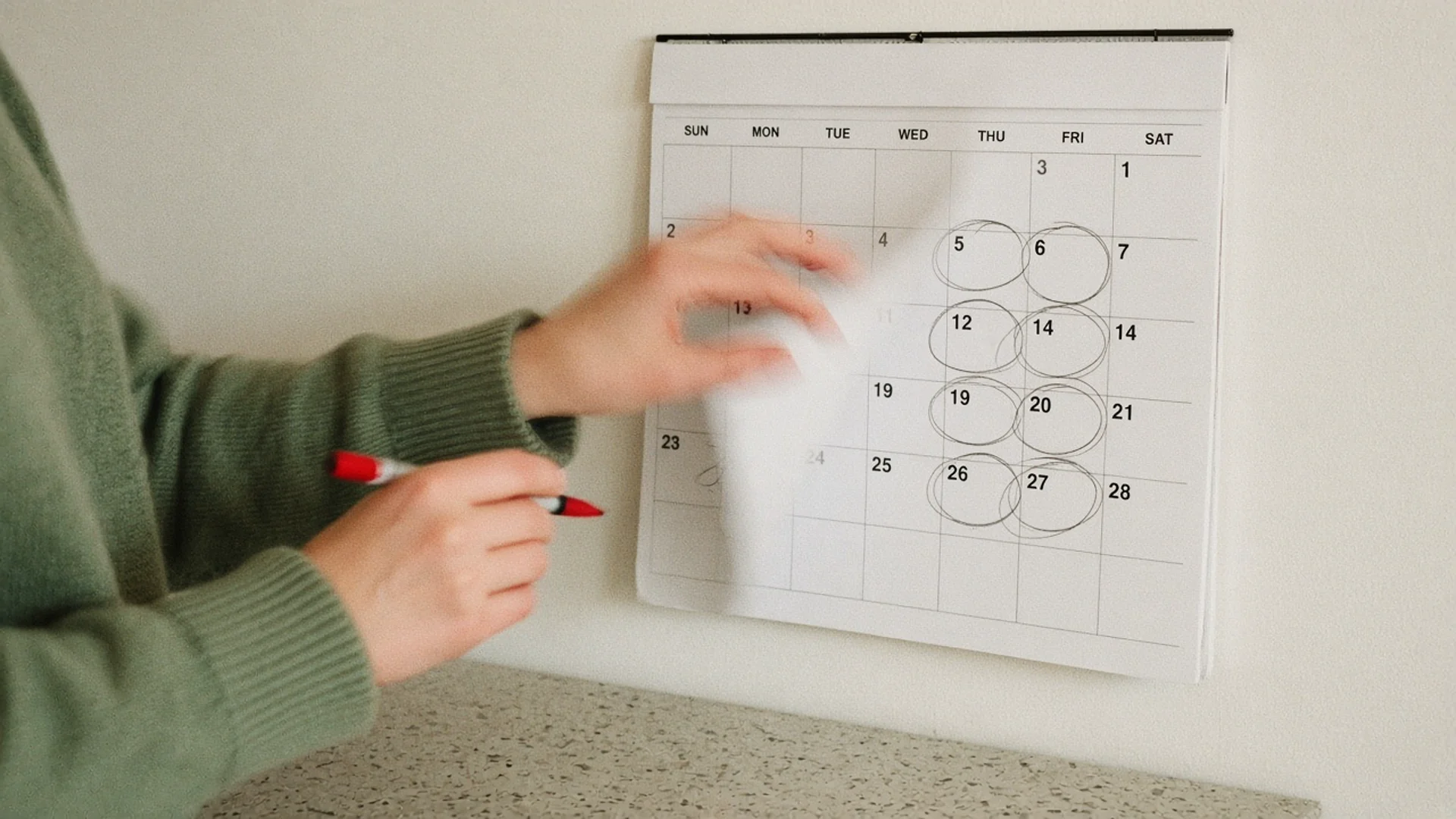
Circle the weeks before you start, not after the chart looks nice. Editorial image in Classic disposable-camera style.
Teams ask “how long” as if there is a fashion-industry standard. There is not. Duration is a function of baseline, the lift you care about, how lumpy your weeks are, and whether you can leave the flag alone. This page is the planning, not a sample-size calculator that pretends certainty.
Shopify A/B testing for store content (where your plan includes it) and theme app embeds are implementation details. The calendar is the decision.
Estimate baseline and minimum detectable effect
Write two numbers before anyone designs a variant.
Baseline. Use completed checkout rate (or add-to-cart, if that is the only metric with volume) for the exact population you will randomize: for example, mobile PDP sessions on dresses, human traffic, last 28 days. Store-wide conversion is usually the wrong baseline. Conversion engine metrics explains why blended rates hide the test.
Minimum detectable effect (MDE). The smallest relative change that would change a decision. If you would not ship a 3 percent lift because implementation cost is high, do not power for 3 percent. If you would turn the widget off for a 10 percent drop, you still need enough data to see a drop that size.
Illustrative planning table, not a benchmark:
| Baseline CR | Relative MDE you care about | Traffic pattern | Planning note |
|---|---|---|---|
| 2.0% | 20% (to 2.4%) | 4,000 eligible sessions / week | Often a few weeks if the effect is real and large |
| 2.0% | 5% (to 2.1%) | 4,000 eligible sessions / week | Often months; say so |
| 1.0% | 10% | 1,500 eligible sessions / week | Underpowered for PDP CRO; test a coarser slice |
I am not going to print a fake n from a black-box calculator. Use any standard two-proportion sample-size formula, or a vendor calculator, with your baseline and MDE, then add the weekly-cycle padding in the next section. If the formula wants 400,000 sessions and you have 8,000 a month, you do not have a four-week test. You have a year-long test or a different question.
Eligible sessions means sessions that could have seen try-on: the template, the device, the SKUs in the test. Theme editor and bot traffic do not count. Shopify bot filtering should be on.
Include weekly cycles
Fashion demand is not Poisson noise around a mean. Tuesday email, Thursday creator post, Saturday organic, payday. A seven-day test can “win” because it captured one email.
Rules:
- Run in whole weeks. Minimum two full weekly cycles if you have a weekly email. Three is better when you also run ads with weekday bias.
- Do not start on the first day of a sale and end on the last. Either exclude promo weeks or put the same promo in both variants.
- If you have a drop date, the drop week is not a clean test week. Start after the spike or treat the drop as a separate cut.
Product page engagement quality will move in those same weeks. Engagement is not your stopping rule.
Pay cycle and season matter more than statistical independence assumptions. A test that overlaps Black Friday and the following quiet week is two tests glued together.
Avoid peeking
Peeking is opening the dashboard every morning and stopping when the variant is green. It inflates false winners. Sequential testing methods exist. Most merchant stacks do not implement them. The practical control is a freeze.
Write on the brief:
- End date and primary metric, chosen in advance.
- One optional guardrail check (speed, refunds) that can stop the test early for harm, not for a win.
- No “winning variant” emails until the end date.
If a founder wants a peek, send the session counts, not the conversion rates.
Harm checks are allowed because a broken upload flow can torch mobile conversion. That is a quality freeze, not a victory lap. The Shopify PDP conversion checklist is a good preflight so you are not A/B testing a half-installed widget.
State statistical limits
Limits you should say out loud in the doc that launches the test:
- You will not prove small lifts quickly. A 2 percent relative move on a 2 percent CR is 4 basis points. Most stores cannot see that in a month.
- Selected-group conversion is not the A/B. Users who try on vs users who do not is not a randomized test.
- Multiple metrics need a primary. If you watch CR, AOV, and returns, one of them will look good by chance.
- Holdouts on SKUs are not the same as session randomization. SKU holdouts leak when merchandising treats the groups differently.
- Underpowered tests should not ship a “no difference” claim. Absence of a detected lift is not proof of zero lift.
Early-stage stores should read first 90 days of fashion metrics before promising a CRO program. If you do not yet have a stable baseline, you do not have a duration. You have a wait.
Returns can be a secondary metric with a longer horizon than the conversion test. Do not end the A/B on Friday and read 30-day returns on Monday. Fashion return rate benchmarks are context, not your stopping rule.
Limits of this plan
This is not a statistics course. It will not give you a p-value. It will stop you from running a five-day test on a 1 percent baseline and calling it science.
If legal or finance needs a formal power analysis, hire that. Bring them the baseline, MDE, and weekly cycle, not a screenshot of starts.
One more calendar rule: do not stack this test on a theme rewrite. If development is shipping a new PDP in the same window, you will not know which change moved conversion. Either freeze the theme or freeze the try-on flag. The conversion engine definition is useful here: one interaction layer at a time, or you cannot attribute.
If traffic is seasonal, use last year’s week-of-year as a sanity check, not as a control. Last year did not have your new collection. It only tells you whether this week is usually loud.
Next action
Export 28 days of eligible sessions and completed checkouts for the population you would randomize. Write baseline CR and the smallest lift that would change the buy decision. Convert that to whole weeks. Put the end date on a calendar. Then build the variant.
About the author: Aaron writes about fashion storefront measurement and spends an unreasonable share of his week reading product pages on a phone.