

Does Virtual Try-On Work? An Honest Look at the Evidence
Does virtual try-on work? This 2026 guide covers render accuracy, honest limits, and Shopify fashion metrics that prove whether try-on earns PDP space.

Your conversion dashboard says the shopper spent four minutes on the dress PDP. She opened the size chart twice. She never added to cart. Something in the funnel is working. The decision is not.
That pattern is why merchants keep asking the blunt version of the question: does this actually work, or is it another PDP widget that collects clicks and disappears at checkout?
Yes, virtual try-on works in 2026 when you judge it on the right criteria. Modern AI try-on renders garments on a shopper’s own photo with enough photorealism to change fit decisions on silhouette-sensitive categories. It does not replace fabric hand-feel or millimeter-perfect hem prediction, and weak product photography still caps results.
This article unpacks what “work” means in practice, why skepticism from older AR tools is partly outdated, where the evidence is strongest, and where honest merchants should still set expectations.
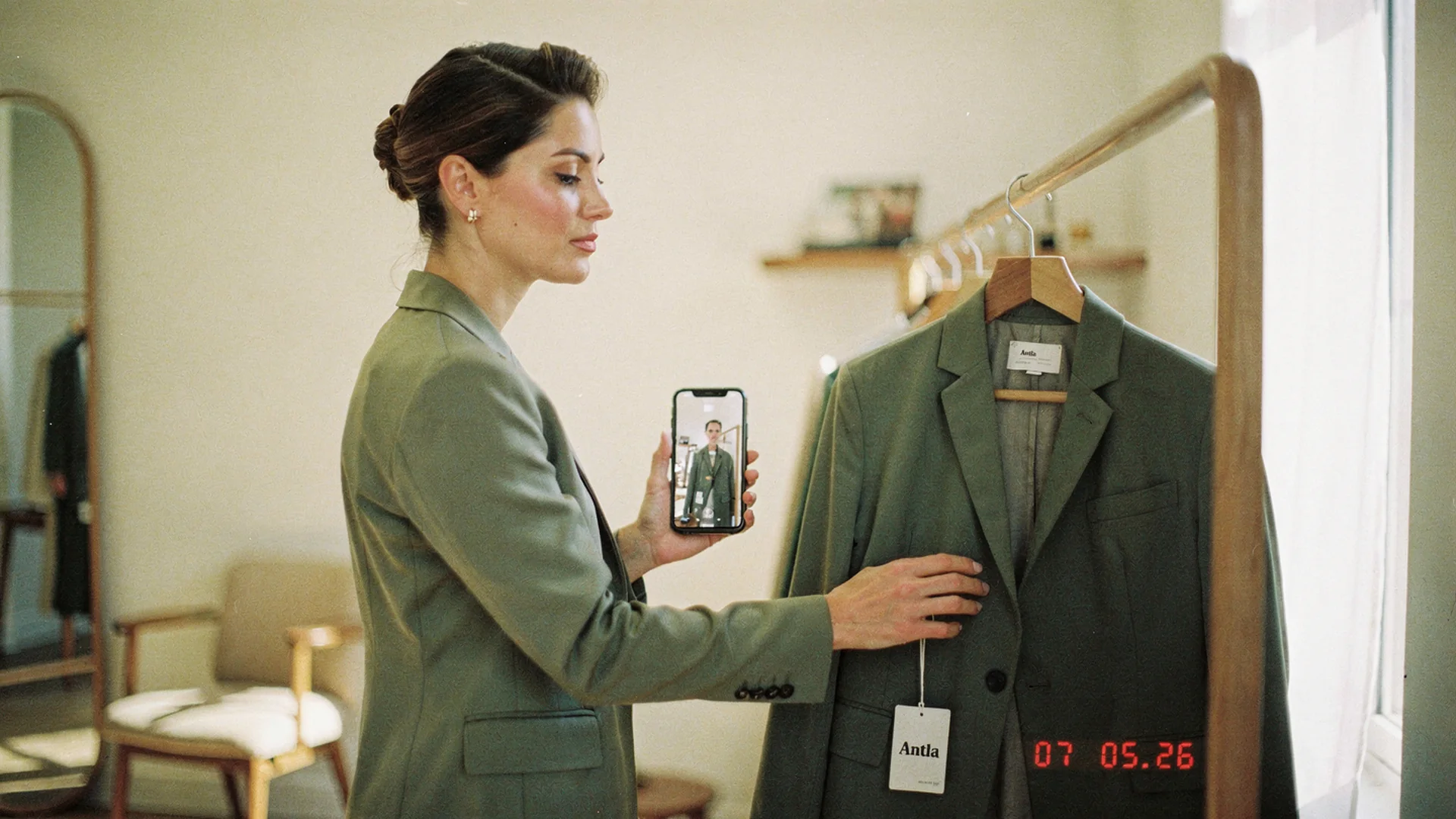
Conversion teams should judge try-on on decision quality and cohort metrics, not only on whether the render looks impressive in a demo. Antla’s 1950s film-inspired editorial captures the quality bar timeless fashion brands expect from virtual try-on.
Three Different Questions Hidden Inside “Does It Work?”
Shoppers, merchants, and investors rarely mean the same thing when they ask whether virtual try-on works. Split the question before you evaluate any vendor demo.
Render accuracy
Does the preview look believable on the uploaded photo? Seams, neckline placement, hem line, and overall proportion should read as the garment on that body, not a sticker pasted over a selfie.
Decision quality
Does the preview help the shopper choose with less defensive hedging? Fewer backup sizes, less cart abandonment after long dwell time, more confident add-to-cart on high-hesitation SKUs.
Business metrics
Does try-on move conversion, engagement, and return mix in a measurable cohort comparison? A beautiful render that nobody uses is a design exercise. A modest render that shifts order quality is infrastructure.
CRO teams should score all three. Marketing teams often stop at the first. That is how good-looking tools end up on PDPs that still leak revenue.
Why 2026 AI Try-On Is Not the AR Shoppers Remember
A lot of skepticism is earned. Early AR shopping tools from the late 2010s often floated flat graphics over a live camera feed. The garment did not drape. The body was generic. The preview felt like a filter, not a fitting room.
Shopify’s AR shopping overview documents that generation accurately: useful for novelty and certain accessory categories, weaker for apparel where silhouette and fabric behavior matter.
The current AI generation works differently. The shopper uploads a photo. The system reads your existing product image and generates a new composite showing that SKU on her body. No 3D garment scan required. No avatar with someone else’s proportions.
Business of Fashion on generative AI try-on frames the shift as an economics change as much as a quality change. Photo-based generation collapsed the asset pipeline that kept mid-size brands off legacy virtual fitting rooms for years.
That does not mean every implementation is excellent. It means the 2019 demo you remember is a poor proxy for what a Shopify fashion store can deploy today from standard PDP photography.
For a photography lens on the same question, read product photography vs AI virtual try-on. Bad source images still produce bad previews. The tech does not rescue a dark, cropped, or misleading hero shot.
Behavioral Evidence: Engagement, Conversion, and Returns
Research on virtual try-on has moved past novelty metrics. The stronger studies connect preview to purchase psychology.
Marketing research on visual saliency and consumer choice shows that what shoppers can see clearly disproportionately drives what they choose, even against stated preferences. A self-referenced preview raises the visual evidence available at the decision moment. Shoppers spend more mental effort evaluating the item because the preview gives them more to evaluate.
That mechanism matters for CRO. Long PDP dwell without add-to-cart often signals unresolved simulation, not lack of interest. Try-on gives the shopper a self-referenced image to reason with.
Antla first-party data from 100+ Shopify fashion brands supports the commercial layer. Shoppers who use try-on convert 35% higher on average than shoppers who do not on the same stores. PDP sessions that include an active preview commonly run two to three times longer, which is consistent with deeper evaluation rather than passive scrolling.
Returns are the downstream check on whether decisions improved or merely delayed. For that evidence stack, see does virtual try-on reduce returns. When preview closes the visual expectation gap, return reason codes shift away from looked different and not flattering.
The psychology layer is worth reading in parallel. Psychology of virtual try-on in fashion ecommerce explains why self-referenced preview changes confidence differently than model photography alone.
Where the Technology Still Misses
Honest adoption requires honest limits. Merchants who oversell preview create the next wave of “looked different” returns.
Unusual fabrics and extreme drape
Heavy satin, stiff taffeta, liquid jersey, and sculptural neoprene behave differently in motion than in a still render. AI try-on is strong at showing overall silhouette. It is weaker when the purchase decision hinges on how a skirt fans when walking or how a bodice holds structure under tension.
Exact length prediction
Floor-length occasion dresses, cropped hemlines, and tea-length cuts are sensitive to height and torso length in ways a single photo may not fully resolve. Try-on gives a strong directional read. It is not a tailor’s tape.
Fabric feel, stretch recovery, and lining
No preview tells the shopper whether the fabric scratches, clings in humidity, or relaxes after two hours. Stretch percentage and lining comfort still belong in fit notes and reviews.
Undergarment interaction
Structured gowns, built-in corsetry, and backless silhouettes depend on bra and shapewear choices. Try-on shows the dress on the body presented. It does not simulate every undergarment combination unless the shopper adjusts styling context herself.
These limits are why try-on works best as one layer in a serious PDP, not a replacement for measurements, model context, and merchant-written fit notes.
A Six-Point Quality Audit Before You Trust Any Tool
Whether you are a shopper testing a new app or a merchant evaluating vendors, run this quick audit on five real SKUs from your catalog, not the vendor’s showcase gallery.
- Garment boundary fidelity. Do shoulders, armholes, and waist seams land where they should, or does the item look painted on?
- Proportion preservation. Does the preview respect the shopper’s shoulder width and torso length, or does it silently slim or lengthen the body?
- Product photo honesty. Test against your actual hero images. If only the vendor’s sample photography works, your catalog will suffer.
- Category stress test. Run a fitted midi dress, a boxy blazer, and wide-leg denim. Silhouette diversity exposes weak models fast.
- Speed on mobile. A 40-second wait on LTE loses the shopper who was ready to decide. Generation time is a conversion variable.
- Cohort measurability. Can you compare try-on users vs non-users on the same SKU without hand-waving?
Antla virtual try-on is built for Shopify fashion merchants who want this audit to pass on real product photography, not demo assets only.
What “Virtual Try-On Works” Looks Like on a Shopify PDP
Working does not mean universal perfection. It means measurable movement on categories where visual uncertainty was the blocker.
A practical working definition for a CRO-led pilot:
- Try-on start rate climbs when the button sits near core media on mobile
- Try-on user conversion beats non-user conversion on the same SKU
- Bracketing softens on pilot categories
- Fit-related return reasons fall in the cohort that previewed
If engagement rises but conversion and return mix stay flat, you likely have a placement or photography problem, not proof that try-on failed as a category.
For the adoption frame around rollout sequencing, start with AI virtual try-on for Shopify. That hub covers when to adopt, not only whether the render looks convincing in isolation.
Frequently Asked Questions
Is virtual try-on accurate enough to trust for fit decisions?
For silhouette, length direction, and overall proportion on most apparel, modern AI try-on is accurate enough to change decisions when product photography is clean. It is not a substitute for garment measurements or tactile fabric knowledge. Treat it as visual evidence, not a size oracle.
Does virtual try-on show real fit on my body?
Good implementations render the catalog item on your uploaded photo, not a generic mannequin body. Accuracy depends on photo quality, garment type, and the underlying model. Structured pieces and straightforward silhouettes tend to preview more reliably than extreme draping or heavily layered construction.
Is my photo safe when I use virtual try-on?
Reputable Shopify apps disclose how images are processed, stored, and deleted. Merchants should read the vendor privacy policy, enable terms acceptance if required, and choose providers that process try-on images for generation rather than unrelated marketing reuse. Shoppers should prefer stores that link to a clear policy from the try-on flow.
Does virtual try-on work for every fashion category equally?
No. Impact concentrates where shoppers struggle to simulate outcome: dresses, denim, tailored pieces, and occasionwear. Forgiving basics with stretch may see smaller decision changes even when engagement rises. Pilot on categories with long dwell time and weak conversion first.
Go Deeper on Try-On Evidence
About the author: Aaron is the founder of Antla. After years of frustrating returns, never looking like the supermodels on product pages, he set out to make fashion personal by helping shoppers see themselves in the outfits they want to buy. He treats try-on as a conversion variable you can cohort-test, not a novelty badge.
If your PDPs earn attention but not commitment, run the six-point audit on five real SKUs. Then pilot one silhouette-sensitive category through Antla on the Shopify App Store and compare try-on users against everyone else who saw the same page.