

Virtual Try-On Technology in Fashion: AR to AI Photorealism
Virtual try-on technology in fashion spans AR overlays, 3D avatars, and generative AI. Compare generations, failure modes, and what changed for brands.

In 2017, conference demos showed a dress floating over a phone camera like a digital sticker. Headlines promised the end of fitting-room anxiety. Merchants who piloted those tools got a different result: shoppers laughed once, screenshot the absurd overlay, and went back to scrolling flat product photos.
The gap between demo and decision was not shopper resistance. It was technology generation. Early virtual try-on promised mirror realism and delivered filter novelty.
Virtual try-on technology in fashion is software that lets shoppers preview how a garment will look on their own body or avatar before purchase, using catalog assets plus shopper photos or body inputs. Modern systems use generative AI for photorealistic renders; earlier generations relied on 2D camera overlays or generic 3D mannequins with limited drape fidelity.
Understanding those generations matters for brand teams evaluating vendors in 2026. The label “virtual try-on” still covers experiences with wildly different adoption cost, render quality, and failure modes.
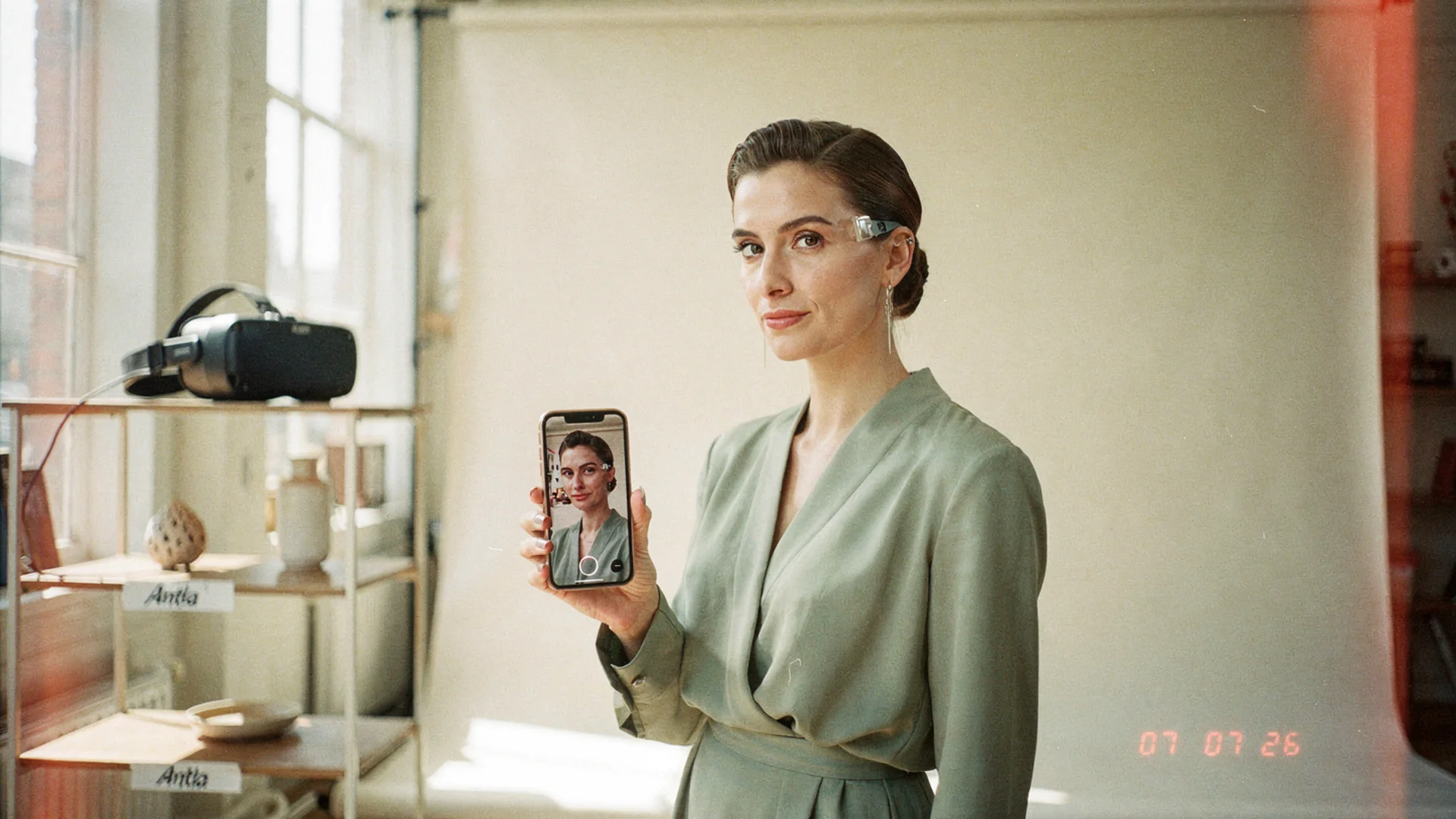
Fashion virtual try-on moved from camera stickers to AI renders that use existing product photography instead of custom 3D assets. Hero image in 1950s film-inspired Antla style, nodding to the timeless brands our fashion customers represent.
Generation One: 2D AR Overlays on the Live Camera
The first wave mapped a flat garment graphic onto a live camera feed. Snapchat filters and early retail AR kits popularized the pattern.
What it needed: A 2D product cutout, face or body tracking, and a mobile camera.
What it showed: A rough overlay that followed movement but did not respect fabric physics, body volume, or lighting consistency.
Where it failed: Shoppers saw a sticker, not themselves wearing the item. Silhouette was approximate. Long garments, layering, and back views were essentially absent. Engagement spiked around novelty, then faded.
Adoption cost: Lower than 3D pipelines, but still required per-SKU creative work and often a custom app or Snapchat lens strategy rather than a PDP embed.
Platform vendors kept improving tracking, and Snap’s ARES Shopping Suite now supports clothing try-on from photo upload with more retail integration. The generation matured, but the core limitation remains: without generative rendering, a 2D overlay cannot answer how a structured blazer sits on a specific torso.
Generation Two: 3D Avatar Fitting Rooms
The second wave built digital showrooms. Shoppers picked a body avatar, sometimes adjusted measurements, and dressed a 3D mannequin in simulated garments.
What it needed: 3D garment models, often one per SKU, plus avatar libraries and a WebGL or app-based viewer.
What it showed: Rotatable garments on a body that approximated the shopper’s shape. Better for exploring silhouette than Generation One.
Where it failed: Avatars still looked generic. Drape simulation was expensive to get right. Merchants faced six-figure asset pipelines for full catalogs. Maintenance broke when seasonal drops arrived weekly.
Adoption cost: High. Shopify’s virtual fitting room research traces years of commercial effort on 3D garment simulation, much of it stalled by per-SKU asset cost and uncanny output. Mid-size fashion brands rarely justified the build.
Virtual fitting rooms still exist in enterprise retail and made-to-measure workflows. For fast-fashion Shopify catalogs, the economics rarely closed.
Generation Three: Generative AI Photorealistic Try-On
The current wave uses generative image models to place a garment from product photography onto the shopper’s uploaded photo.
What it needs: Existing PDP photography, a shopper selfie or full-body image, and an AI render pipeline. No per-SKU 3D mesh.
What it shows: A still preview that aims for photorealism: proportion, placement, and context on the shopper’s actual image.
Where it fails: Unusual poses, heavy layering, transparent fabrics, and extreme length still challenge models. Speed vs quality tradeoffs remain. Privacy policies must be explicit about photo handling.
Adoption cost: Collapsed relative to Generation Two. Business of Fashion’s generative try-on coverage describes the shift as a move from asset factories to inference on catalog photos, which is why Shopify fashion brands can pilot in days instead of quarters.
This is the generation AI virtual try-on in ecommerce focuses on: photoreal preview from standard merchandising assets.
Virtual Try-On Technology in Fashion: Three Generations Compared
| Dimension | 2D AR overlay | 3D avatar fitting room | Generative AI try-on |
|---|---|---|---|
| What it needs | 2D cutouts, camera tracking | 3D garment meshes, avatar system | Product photos + shopper photo |
| What it shows | Floating graphic on live video | Rotatable garment on generic body | Still render on shopper’s image |
| Where it fails | No real fit physics, novelty fade | Uncanny avatars, asset cost | Hard fabrics, complex layering, latency |
| Adoption cost | Low–medium per SKU creative | High catalog-wide 3D build | Low no-code app install on Shopify |
The table explains why vendor conversations confuse merchants. All three get called “virtual try-on.” Only the third generation matches what most Shopify fashion teams now mean by AI try-on on the PDP.
Virtual Try-On vs Virtual Fitting Room
Retail copy mixes terms. Brand strategists should separate them.
Virtual try-on (VTO) usually means previewing a specific catalog SKU on the shopper or her photo. The goal is purchase confidence for that item.
Virtual fitting room (VFR) usually means a multi-item staging environment: mix tops and bottoms, sometimes in a 3D room, before adding to cart.
Overlap exists. A generative try-on widget on a dress PDP is VTO. A browser-based avatar closet where she builds three outfits is closer to VFR. For returns and conversion work, VTO on the PDP tends to be the faster commercial test because it attaches to a single high-hesitation SKU.
Does virtual try-on work? evaluates output quality and shopper trust in 2026 tools. This article stays on architecture and economics.
What the AI Generation Changed for Mid-Size Brands
Three shifts matter beyond render quality.
Catalog velocity. Seasonal drops no longer wait on 3D modeling queues. Merchandising photography becomes the input.
Theme-agnostic deployment. Apps embed on Shopify PDPs without rebuilding the storefront.
Measurable behavior. Shoppers who preview stay longer and convert more often when the render is credible. Google and Vogue Business’s Unfolding AI study documents strong consumer interest in AR try-on among values-driven shoppers, which matches what Antla sees in production stores: credibility of the preview drives usage, not the technology label.
Antla merchant data puts engagement at roughly two to three times longer on site among shoppers who actively use try-on. On women’s PDPs where silhouette drives the purchase decision, conversion among try-on users can approach double the non-user rate on the same product. The app holds a 5-star rating from 80+ reviews on the Shopify App Store, which reflects merchant tolerance for setup friction more than slide-deck promises.
Those outcomes sit in the psychology layer too. Psychology of virtual try-on in fashion ecommerce explains why self-referenced preview changes decision quality rather than just time on page.
How Brand Teams Should Evaluate the Technology
Vendor selection should score the tech itself, not the sales deck.
Render fidelity on your SKUs. Test structured tailoring, fluid dresses, and prints that warp easily. If the vendor only demos on plain tees, widen the test.
Generation speed. Fast renders keep mobile shoppers in flow. Slower models need clear progress UI.
Photo privacy. Where uploads go, retention period, and whether processing happens in-region for your compliance team.
Catalog fit. Photo-based AI works from standard PDP assets. If your photography is inconsistent, fix imaging before blaming the model.
Placement control. The button should live near core media, not a footer tab. AI virtual try-on for Shopify covers rollout signals and category choice for the adoption decision.
Antla virtual try-on is built for that evaluation path: install on a pilot category, compare try-on users against holdouts, read conversion and return mix.
Where the Technology Goes Next
Short-term movement is incremental, not magical.
Faster models reduce wait friction on mobile PDPs.
Video and multi-angle previews will test whether motion increases confidence or just increases render cost.
Look-level try-on (full outfit staging) will blur the VTO/VFR line for campaign use, especially email and social reuse of shopper-generated previews.
On-device processing will matter more as privacy regulation tightens in EU and UK markets.
None of that removes the merchant homework: clean photography, honest fit notes, and category selection where visualization moves revenue.
Frequently Asked Questions
What is virtual try-on technology in fashion?
Virtual try-on technology lets shoppers preview how a specific garment will look on their body or avatar before buying, using product catalog assets combined with shopper photos or body measurements. The latest generation uses generative AI to produce photorealistic still previews from standard product photography.
How is virtual try-on different from a virtual fitting room?
Virtual try-on typically previews one catalog SKU on the shopper, often directly on the product page. A virtual fitting room usually stages multiple items together in a simulated space. Both reduce uncertainty, but VTO attaches to single-SKU decisions while VFR supports outfit building.
Which virtual try-on generation should a Shopify fashion brand adopt in 2026?
Most mid-size Shopify fashion brands should evaluate generative AI photo-based try-on first. It avoids the 3D asset cost of avatar fitting rooms and produces more decision-relevant output than 2D camera overlays. Pilot on fit-sensitive categories before scaling site-wide.
Related Guides From the Antla Blog
- Virtual try-on benefits for fashion stores ranked by merchant impact
- Virtual try-on software cost for pricing across the three generations
- Virtual try-on for wedding and prom dresses for the category where render quality matters most
About the author: Aaron is the founder of Antla. After years of frustrating returns, never looking like the supermodels on product pages, he set out to make fashion personal by helping shoppers see themselves in the outfits they want to buy. He has watched three generations of try-on hype and only backs tools that survive a skeptical merchandising review.
If your brand is still treating try-on like a 2019 AR experiment, rerun the evaluation against generative photo-based tools. Start with Antla on the Shopify App Store, pilot one silhouette-sensitive category, and compare render quality on your hardest SKUs before you commit catalog-wide.