

ChatGPT Virtual Try-On: What Shopify Merchants Should Know
OpenAI added virtual try-on to ChatGPT shopping on 1 Oct 2026. How chat previews differ from Shopify PDP try-on, and what fashion merchants should do this week.

TechCrunch reported on 1 October 2026 that ChatGPT can now virtually try on clothes. That headline will land in merchant Slack channels as “OpenAI just built a fitting room.” It did not. It built a consumer shopping preview inside a chat product.
ChatGPT virtual try-on is a consumer feature in ChatGPT shopping results. A user uploads a selfie or a full-body photo, taps Try On on a clothing or accessory listing, and gets a generated preview. OpenAI says the images use ChatGPT Images 2.5. The job is discovery in chat. It is not Shopify product-page conversion, and it does not prove the garment will fit.
If you sell fashion on Shopify, the useful question is narrower than “is this a competitor?” It is: what job does a chat preview do, what job does an on-site try-on do, and what should you change this week besides forwarding the article.
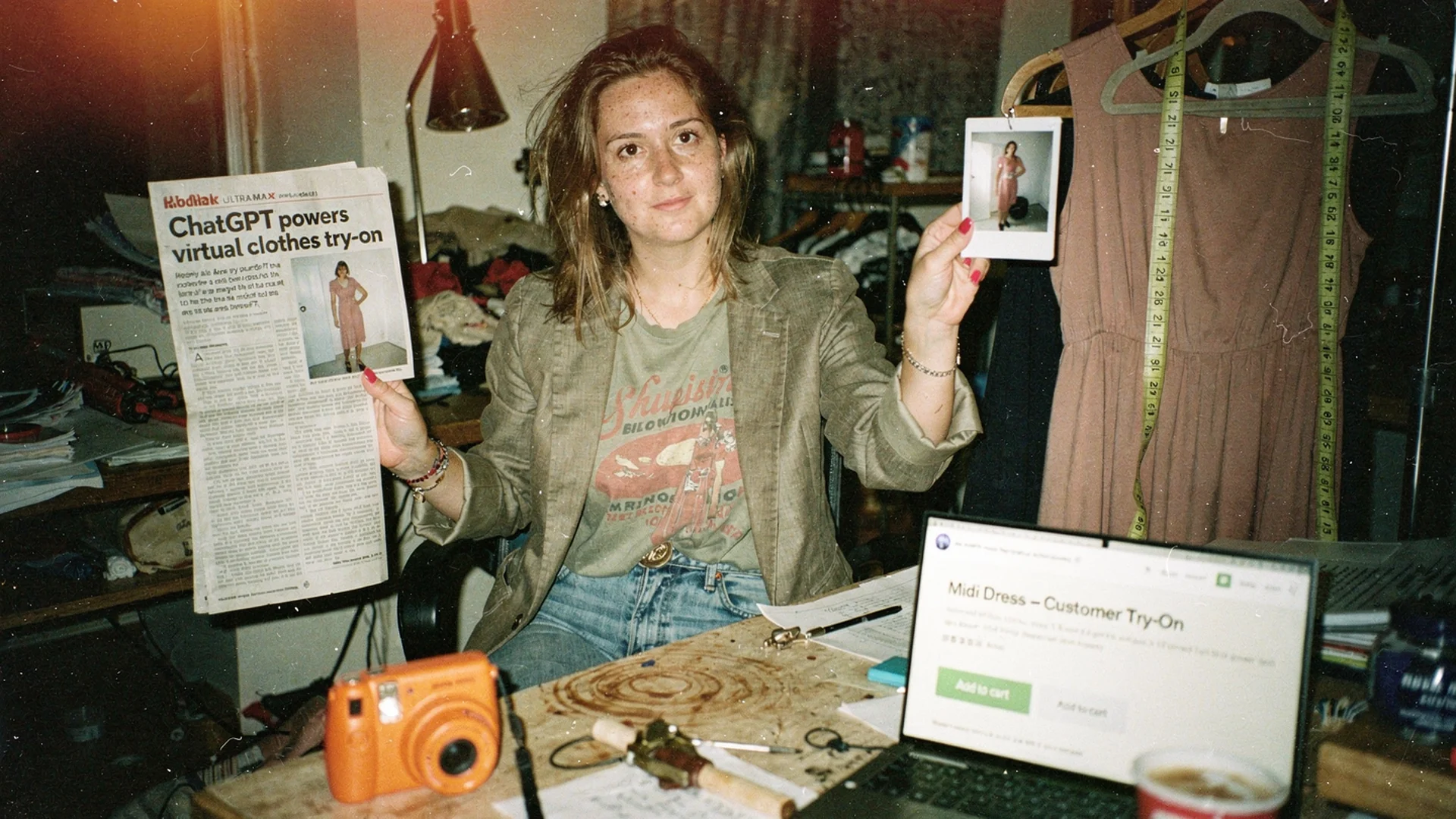
A chat preview and a product-page preview can look similar in a screenshot. They sit in different buying moments. Classic Antla disposable-camera editorial, 2 October 2026.
What OpenAI actually shipped
Sarah Perez’s TechCrunch piece is the cleanest public recap of the launch. OpenAI announced a global rollout of two shopping features: virtual try-on for clothing and accessories, and a Favorites function that saves products into a Library in the app, including try-on images.
The try-on path, as TechCrunch describes it:
- A Try On button appears in ChatGPT shopping results for clothing and accessories
- The user uploads a selfie or a full-body photo
- ChatGPT generates a visualization of the item on that person
- Users can also upload an image of an item, including a web screenshot, and ask ChatGPT to try it on
Search Engine Roundtable quoted OpenAI’s own copy: a Try On button will appear on product listings for clothes and accessories, and users take or upload a selfie to generate a try-on with ChatGPT Images. Reference photos are saved for later try-ons and can be changed or deleted under Settings, then Personalization, then Reference photos.
That last point is operational, not cosmetic. A saved reference photo makes repeat try-ons faster. It also means the assistant is storing a body image for reuse. Android Authority’s write-up matches that settings path.
OpenAI already sells the image model in public. On 8 September 2026 it introduced ChatGPT Images 2.5, claiming more natural lighting and richer textures, better preservation of subjects in reference photos, more reliable editing instructions, and up to 50% lower image-generation latency versus Images 2.0. TechCrunch says the shopping try-on uses that model. Treat those as OpenAI’s quality claims, not as independent apparel-fit tests.
ChatGPT shopping is also not new. OpenAI’s help article Shopping with ChatGPT Search already covered product carousels, merchant lists, and Instant Checkout for some eligible products. TechCrunch notes that Instant Checkout did not perform well and that OpenAI pivoted. I am not going to invent a conversion rate for that experiment. The point for merchants is simpler: OpenAI is still iterating on how ChatGPT participates in buying, and try-on is the latest surface.
The same TechCrunch story says ChatGPT can shop from a style description, or from a celebrity outfit photo, then surface purchasable items. That is visual discovery, the job Pinterest and Google Shopping have been fighting over for years. It is not a replacement for your PDP.
Consumer try-on was already here
TechCrunch ends on the comparison everyone in fashion already made: Google launched virtual try-on last year.
On 20 May 2025, Google’s shopping blog announced that shoppers could virtually try on apparel listings using their own photo. The experiment started in Search Labs in the US. Google later documented the merchant-facing version in Merchant Center Help. Eligible feed listings can show a Try it on control on non-sponsored Search, Shopping, and Images results. Lingerie, bathing suits, and accessories are called out as unsupported. Shopping Ads do not get the button. Generated images can include mistakes in body shape, personal features, or garment details. The preview can help people see how an item might look. It does not indicate fit or suggest a size.
The Verge made the same Google comparison on 2 October 2026, and flagged a demo image in which ChatGPT appeared to dye and restyle hair without being asked. That is one screenshot, not a lab study. It is still a useful reminder: a generated preview can invent details the listing did not sell.
If your shoppers already try dresses on in Google, ChatGPT joining that habit is market news. It is not a new physics of fit.
Chat try-on and Shopify try-on are different jobs
A generated image of a person in a garment can look similar whether it came from ChatGPT, Google, or a Shopify app. The buying context is not similar.
| ChatGPT try-on | Shopify merchant try-on (Antla) | |
|---|---|---|
| Who owns the session | OpenAI, inside ChatGPT | The merchant, on the store |
| When it happens | Discovery in a chat, often before a store visit | Evaluation on the product page, next to buy |
| Catalog | Listings ChatGPT chooses to surface | The merchant’s own SKUs and product images |
| Merchant control | Product feed / catalog presence, not PDP UX | Theme placement, funnel, photography, events |
| Data the store can use | Limited unless the shopper lands and identifies | Try-on events you can join to cart, orders, email |
| What it can answer | ”Might this look like me?" | "Might this SKU look like me on this page?” |
| What it cannot answer | Whether the size will fit | Whether the size will fit |
Antla is a Shopify app. A shopper uploads a photo, or a selfie that becomes a full-body avatar, and sees the selected garment on herself before add to cart. Setup is no-code and works across Shopify themes. The preview belongs on the product page, near media and buy controls, because that is where fashion hesitation actually kills the order.
That is a conversion job. ChatGPT’s Try On button is a discovery job. Confusing the two is how brands either panic (“we are obsolete”) or shrug (“chatbots do not sell dresses”). Neither is a strategy.
Shopify already has a consumer path into ChatGPT shopping. OpenAI’s help page Shopping from Shopify merchants in ChatGPT points merchants at Shopify’s Agentic Storefronts guidance. Catalog presence can affect whether your products appear in chat. It does not install try-on on your PDP, capture try-on events in Shopify, or put a preview next to your size chart.
I would not claim Antla renders are “better” than ChatGPT Images 2.5. I have not run a side-by-side accuracy study against OpenAI’s shopping results, and I will not fake one. The distinction that matters for a merchant P&L is location and ownership: whose page, whose SKU, whose event, whose follow-up.
If you want the longer operator definition of on-site preview, read does virtual try-on work and the Shopify virtual try-on app guide. Those pages are about PDP evidence. This page is about not misreading a news cycle.
A preview is not a tape measure
This is the sentence I want screenshotted in the Slack thread: virtual try-on does not prove physical fit.
A generated image can show silhouette, neckline, length direction, and color against a specific body. It cannot certify bust ease, rise, stretch recovery, or how a waistband will feel after two hours. Size charts, garment measurements, fabric notes, and reviews still do that work. Mixing the jobs creates “looked different” returns with a new alibi.
We have been blunt about this on Antla’s own property. Virtual try-on vs size charts is the comparison. Charts translate numbers. Try-on translates appearance. Fashion PDPs usually need both. AI size recommendation vs virtual try-on is the other mix-up: a quiz that guesses a label is not a mirror.
Google already writes the visualization caveat into merchant help: generated images can include mistakes, and they do not indicate fit, suggest a size, or show size availability. Treat ChatGPT the same way. Android Authority quotes OpenAI’s support page as saying try-on images may not represent the product or the user accurately, cannot tell you whether a size will fit, and that shoppers should check the merchant’s measurements, product details, and return policy before buying. Do not tell shoppers “try it on in ChatGPT to confirm your size.” That is the opposite of the documented caution.
Returns are still the expensive half of the same gap. NRF and Happy Returns estimated $890 billion in 2024 retail returns. Shopify’s retail returns overview keeps treating evaluation-layer clarity as margin defense. A chat preview that never touches your PDP cannot change those tags by itself.
On-site preview can change them when visualization was the objection. How virtual try-on reduces returns before checkout is the expectation-gap version of that argument. Antla customers have seen returns fall by up to 30% versus their own pre-try-on same-store rate when preview closes the gap before checkout. That is merchant data on stores running Antla virtual try-on, not a claim about ChatGPT shopping. Antla merchant reporting, cohort dates not published.
Shoppers who use Antla try-on convert 35% higher on average than shoppers who do not, on the same stores. Across 500,000+ try-ons, users who complete a preview convert at 3.8%. That is try-on-user conversion, not store-wide conversion. Sessions with an active preview commonly run two to three times longer. Those figures describe an on-site cohort. They say nothing about ChatGPT’s Try On button. Antla merchant reporting, cohort dates not published.
What to do this week, besides forwarding TechCrunch
Skip the all-hands about “the death of brand websites.” Do these five things.
-
Read the actual launch, not the group chat. TechCrunch, OpenAI’s Images 2.5 post, and OpenAI’s shopping help are enough. Note what is documented (button, selfie or full-body photo, screenshots, Favorites, Images 2.5) and what is not (fit accuracy, eligible retailer list, conversion lift).
-
Check whether your products can appear in ChatGPT shopping at all. Start from OpenAI’s Shopify merchant help and Shopify’s Agentic Storefronts docs in admin. Missing titles, images, or availability data will hurt chat discovery whether or not try-on exists. This is catalog hygiene, not a new app install.
-
Keep try-on on the product page for hero silhouettes. Dresses, denim, blazers, swim, anything whose return reason is “looked different on me.” If you do not have on-site preview yet, add virtual try-on to Shopify is the operator sequence: one test SKU, mobile QA, then expand. ChatGPT will not place that block for you.
-
Leave size charts and garment measurements in place. If a shopper tries a midi dress in ChatGPT, then lands on your PDP, she still needs rise, length, and fabric behavior in writing. Baymard’s apparel UX research still treats sizing support as critical on apparel PDPs. Do not delete the chart because a chatbot can draw a neckline.
-
Measure your own try-on cohort, not the news. Compare add-to-cart and conversion for shoppers who complete an on-site preview versus those who do not. Join try-on events to orders. If you cannot name that delta, a headline will not save you.
Engadget also notes the usual ChatGPT image-training caution: images uploaded from a personal account can be used for training unless the user opts out. That is a consumer privacy issue, not a merchant analytics feature. Do not assume ChatGPT try-ons will show up in your Klaviyo account.
Questions this headline is already creating
Does ChatGPT virtual try-on replace a Shopify try-on app?
No. ChatGPT try-on runs in ChatGPT, on listings the assistant surfaces. A Shopify try-on app runs on your product page, on your SKUs, with events you can measure. They can coexist the way Google try-on and an on-site widget already coexist. One is discovery. The other is conversion infrastructure.
Will ChatGPT steal my product-page traffic?
Unknown. OpenAI has not published click-out or conversion numbers for this try-on launch, and I will not invent them. Chat-based shopping can short-circuit browsing. It can also send a shopper to a store with a clearer picture of the garment. Your defense is still a PDP that answers the mirror question when she arrives.
Should I tell customers to try the item on in ChatGPT?
I would not make that the primary fit path. You do not control the render, the catalog, or the follow-up. If a shopper already did it, fine. Your page still needs honest photography, measurements, and, for high-hesitation SKUs, on-site preview.
Does a realistic try-on mean the size is right?
No. Visualization is not a fitting session. Keep charts. Keep reviews. Keep return policies that do not pretend a generated image was a tailor.
Keep the news. Keep the product page.
OpenAI adding clothes try-on to ChatGPT is real, dated, and worth tracking. TechCrunch got the consumer story right. Google already taught shoppers the gesture in 2025. Fashion brands that sell on Shopify still win or lose on the product page, where the shopper has to pick a size and pay.
If you want that page to show the garment on her, not only on your campaign model, install Antla from the Shopify App Store and put try-on next to the buy button on the SKUs that already cause hesitation. Then keep reading the news without letting it rewrite your PDP.