

AI Email Marketing for Fashion on Shopify
Use AI email marketing for fashion on Shopify: segmentation, flows, subject lines, and post-purchase sequences that respect fit-sensitive buyers.

AI email marketing for fashion on Shopify is not about generating more campaigns. It is about sending fewer, sharper messages that match where the shopper stalled in the fit journey.
Fashion lifecycle email fails when every flow screams “20% off” while the shopper still wonders whether the midi dress hits at the knee. AI can personalize timing, subject lines, and product blocks, but it cannot fix dishonest PDPs.
This guide covers flows worth automating, segmentation that respects fit sensitivity, and guardrails so AI does not train bracketing behavior. It connects to the AI tools hub for Shopify fashion merchants.
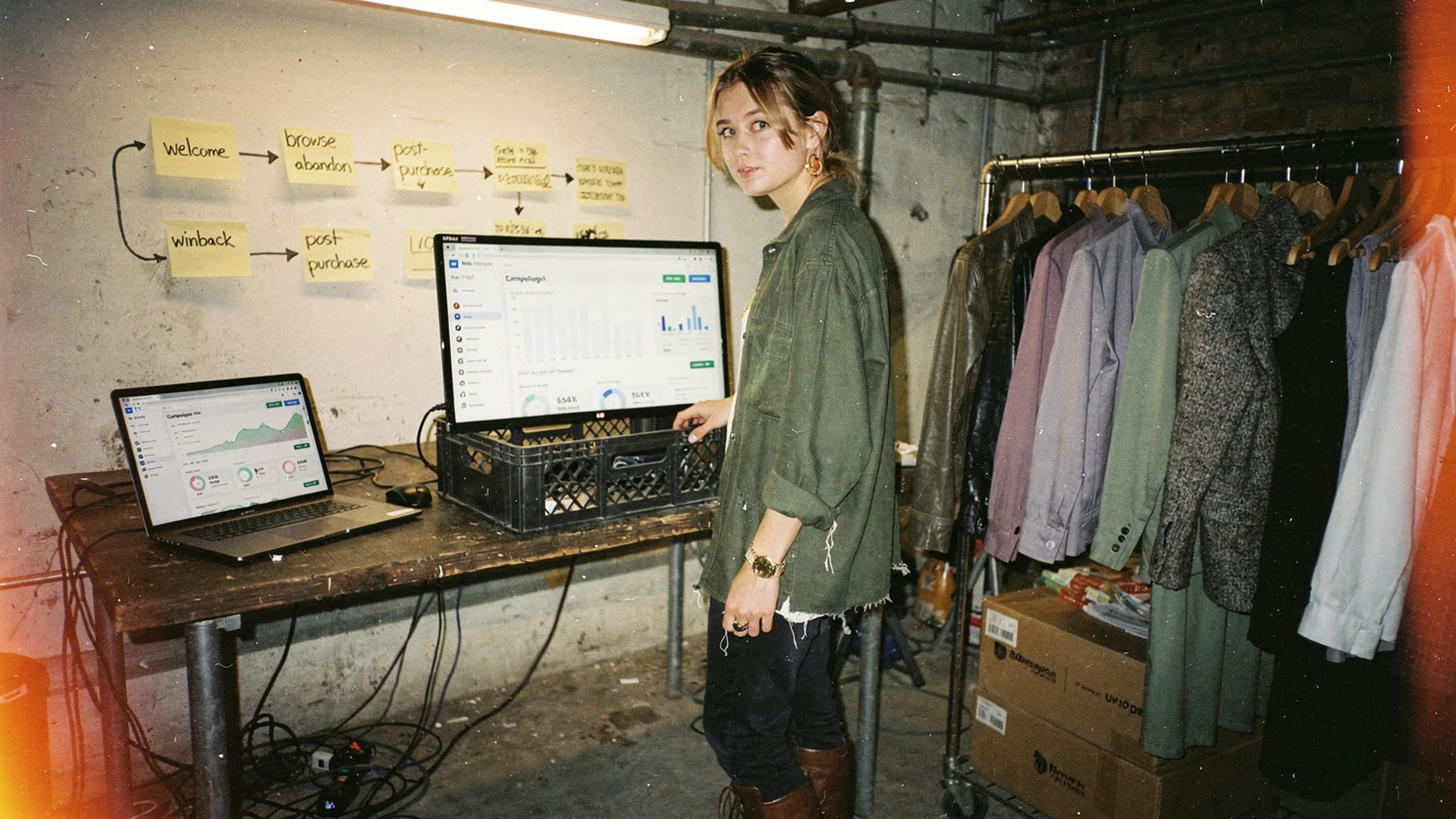
Lifecycle AI should route shoppers back to honest product pages, not replace them with coupon noise.
What AI Email Actually Does In Fashion
Modern ESPs (Klaviyo, Omnisend, Shopify Email, and others) embed AI for:
- Subject line and preview text variants
- Send-time optimization
- Product recommendation blocks
- Segment suggestions from behavior
- Copy drafts for campaigns and flows
Those features save operator time. They do not replace strategy. Strategy starts with knowing which PDP objections block purchase.
Flows Worth Automating First
Prioritize flows with clear intent signals:
Browse abandonment: shopper viewed hero SKU twice, no cart. Recommend the same SKU with fit proof links, not random bestsellers.
Cart abandonment: item in cart, no purchase within two hours. Address shipping or fit anxiety before discounting.
Post-purchase education: care instructions, styling tips, review requests with photo prompts.
Back-in-stock: waitlist for sized-out variants. High intent, low spam risk.
Win-back: lapsed customers with new collection hooks, not perpetual discounts.
Align post-purchase content with photo reviews and social proof for fashion brands so you collect visual proof that reduces future returns.
Segmentation That Respects Fit Sensitivity
Fashion segments that actually move revenue:
- Viewed denim PDPs but never added (often rise/inseam anxiety)
- High AOV dress viewers with short sessions (length uncertainty)
- Customers with fit-related returns (exclude from aggressive upsell until resolved)
- Try-on engagers who did not purchase (follow up with size chart + reviews)
If you run Antla virtual try-on, export try-on engagement as a segment. Those shoppers already invested time; a helpful nudge beats a coupon.
Antla merchants see 2-3x longer engagement on PDPs with try-on. Email should reference what they previewed, not generic “still thinking about it?” copy.
AI Copy Guardrails For Apparel
Ban these patterns from automated drafts:
- “Perfect fit guaranteed”
- “Runs true to size” without category qualifier
- Urgency fake countdowns on evergreen SKUs
- Cross-sell incompatible sizes after fit return
Require human approval on:
- Launch day campaigns
- Legal-sensitive claims
- Segments tagged with prior fit returns
Feed AI prompts with return reasons and PDP attributes from AI product descriptions for fashion.
Subject Lines: Test Ideas, Not Ethics
AI subject line tools excel at variant generation. Merchants still choose what ships.
Test angles:
- Specific garment detail (“Midi length on petites”)
- Social proof (“127 photo reviews this month”)
- Service (“Free exchange if rise is wrong”)
Avoid misleading openers that PDPs contradict. Shopify conversion research ties trust to repeat purchase; one deceptive subject line costs LTV.
Product Blocks And Recommendations
Recommendation AI fails when catalogs are messy: duplicate parents, bad tags, mixed seasonality.
Clean catalog hygiene first:
- Consistent type tags
- Metafields for length and occasion
- Exclude final sale from win-back recommendations
- Suppress categories with active quality holds
Merchandising AI in email should mirror AI merchandising for fashion ecommerce rules, not fight them.
SMS And WhatsApp Handoffs
Email is not the only lifecycle channel. Markets with high WhatsApp usage should route high-intent flows to Dondy or equivalent after email fatigue sets in.
Keep messaging consistent: if email promises inseam detail, WhatsApp macros must match. Read WhatsApp marketing for fashion DTC brands.
Measuring AI Email Without Fake ROAS
Track:
- Revenue per recipient by segment (not blast averages)
- Unsubscribe and spam complaint rate on AI-written campaigns
- Return rate on AI-recommended SKUs within 30 days
- Repeat purchase interval after fit-sensitive first orders
If returns spike on AI-recommended products, fix tags and blocks before generating more copy variants.
Post-Purchase Sequences That Reduce Returns
Educational post-purchase email lowers “care surprise” returns:
- Steam vs wash guidance for structured fabrics
- Layering suggestions that set accurate warmth expectations
- Honest sheer-fabric notes under bright light
Pair education with invitation to preview next purchase using try-on. Shoppers who preview convert 35% higher on average across Antla stores when visualization was the prior blocker.
Connect to virtual try-on reduces returns before checkout.
Seasonal Calendar Integration
Fashion email AI should respect seasonality:
- Preheat waitlists before drops
- Slow win-back during clearance when margins are thin
- Pause aggressive promos when supply chain delays hit
Ops signals from AI inventory forecasting for fashion retail should inform campaign volume, not just ads.
Integration With Discovery Content
Email amplifies content that already ranks or gets cited. Link to helpful blog posts and fit guides rather than orphan landing pages.
Vizby and similar GEO tools help when you need AI-search-ready articles to reference in campaigns. See AI search visibility for fashion Shopify stores.
Small Team Minimum Viable Stack
If you send fewer than eight campaigns per month:
- Three core flows (browse, cart, post-purchase)
- Manual segment review weekly
- AI used for subject variants only
- Human-written body copy for hero launches
Scale AI body generation only when catalog and PDP quality are stable per first 90 days metrics guide.
Frequently Asked Questions
Does AI email marketing work for fashion brands?
Yes when flows target specific intent signals and copy respects fit truth. AI subject lines and send-time optimization save time; discounts alone do not fix PDP gaps.
What email flows should fashion stores automate first?
Browse abandonment, cart abandonment, post-purchase education, back-in-stock, and win-back. Prioritize flows that link back to fit proof on PDPs.
How do I segment fashion email lists with AI?
Segment by viewed categories, try-on engagement, return reasons, and AOV bands. Exclude recent fit-return customers from aggressive upsell until issues resolve.
Should AI write full fashion email campaigns?
Use AI for drafts and variants, but require human approval on launches and fit-sensitive segments. Ban guaranteed-fit language from automated templates.
Can email marketing reduce fashion returns?
Educational post-purchase sequences and honest pre-purchase follow-ups help. Pair email with strong PDPs, reviews, and try-on rather than promising fit in subject lines.
More From This Cluster
- AI customer service for fashion ecommerce
- Shopify AI personalization for fashion
- Build an AI stack for your fashion store
About the author: Aaron is the founder of Antla. After years of frustrating returns, never looking like the supermodels on product pages, he set out to make fashion personal by helping shoppers see themselves in the outfits they want to buy. He sequences lifecycle AI behind fit-proof PDPs because discount blasts cannot answer hem-length anxiety.
Testing flows this month? Send browse-abandon segments to PDPs with Antla try-on enabled on hero SKUs before you scale discount blasts.