

AI Tools for Shopify Fashion Merchants (2026 Guide)
Directory of AI tools for Shopify fashion merchants in 2026: content, support, email, ops, personalization, merchandising, and where virtual try-on fits.

Shopify fashion merchants in 2026 do not lack AI tools. They lack a map.
The App Store lists hundreds of assistants for copy, chat, email, forecasting, and personalization. Most demos look impressive in isolation. On a real store, the failure mode is different: you install five apps that all send slightly wrong messages to the same shopper, while the product page still cannot answer “will this fit me?”
AI tools for Shopify merchants are useful when they remove a specific friction in the buyer journey: discovery, evaluation, purchase, post-purchase, or operations. For fashion, evaluation is often the expensive gap because photography, size charts, and generic descriptions leave body-specific questions unanswered.
This hub is a directory of what to use, what to skip, and where each tool belongs in a fashion stack. Use it once to orient, then open the spoke guides when one job dominates your quarter.
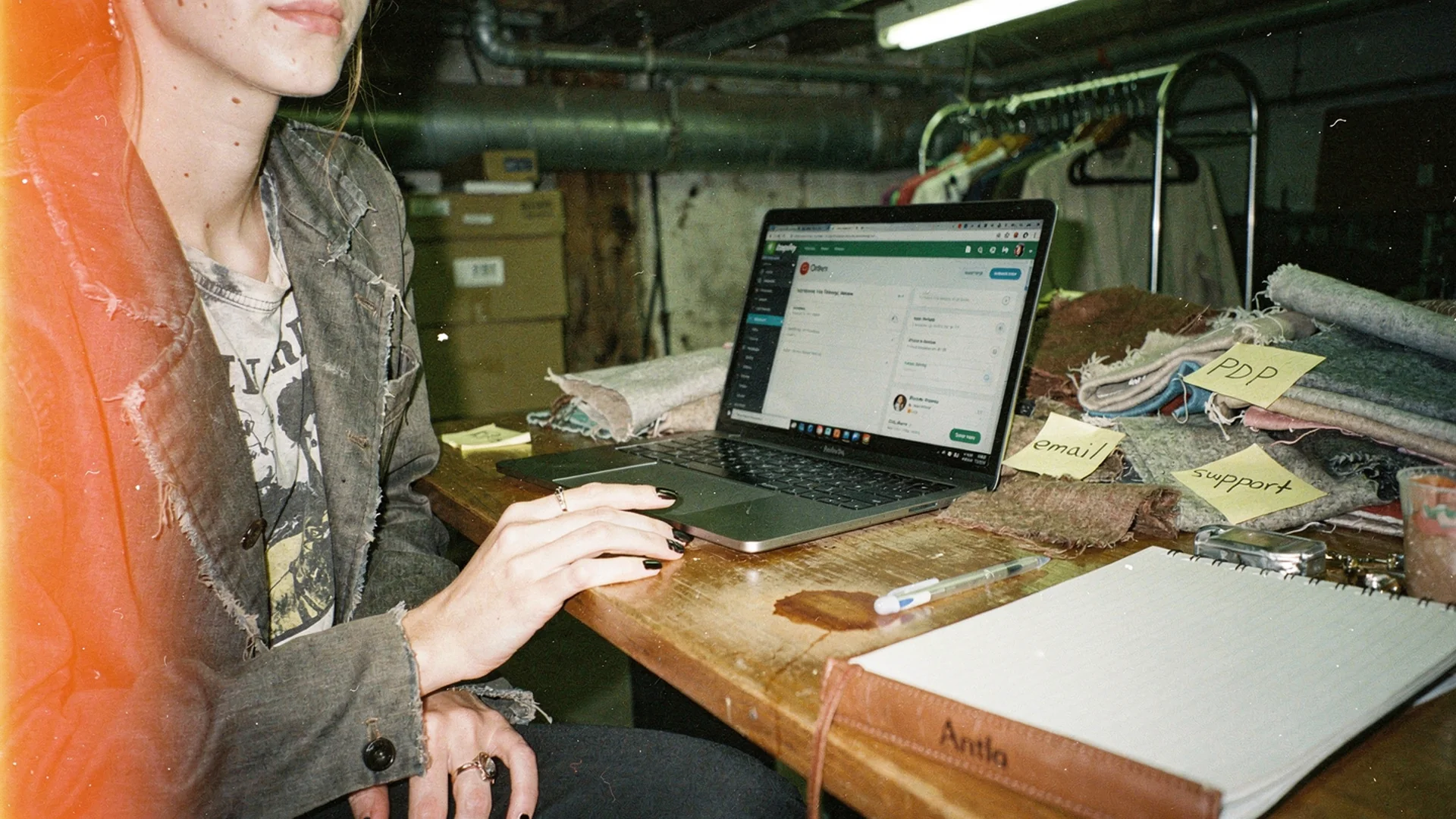
The useful question is not how many AI apps you can install, but which job each one owns in the buyer journey.
What “AI Tools For Shopify Merchants” Actually Means
In practice, merchant-facing AI on Shopify falls into a few lanes:
- Content AI drafts product copy, blog posts, and metadata
- Support AI handles sizing questions, order status, and returns triage
- Lifecycle AI powers email, SMS, and WhatsApp sequences
- Ops AI forecasts demand, suggests replenishment, and flags slow movers
- Personalization AI changes what each visitor sees on site
- Visualization AI helps shoppers preview fit, fabric behavior, or styling
Fashion is not a generic SKU business. Return reasons cluster around length, rise, drape, coverage, and “looked different on me.” Tools that ignore fit physics can still save time, but they rarely move margin until the product page tells the truth.
Google’s helpful content guidance applies here: automation should make pages more useful, not more interchangeable.
The Fashion Stack Layers (And Where AI Fits)
Think in layers, not app count. Our online fashion store AI-era playbook uses the same structure for launch-stage brands.
| Layer | Merchant job | AI tool type | Spoke guide |
|---|---|---|---|
| Discovery | Get found in Google and AI search | Content + GEO | AI search visibility |
| PDP evaluation | Reduce fit anxiety before checkout | Visualization + reviews | Best virtual try-on hub |
| Trust | Show real bodies and outcomes | UGC + reviews | Photo reviews guide |
| Conversation | Recover carts, answer sizing | Chat + WhatsApp | WhatsApp for fashion DTC |
| Lifecycle | Nurture and repeat purchase | Email AI | Email marketing spoke |
| Ops | Buy and allocate inventory | Forecasting AI | Inventory forecasting spoke |
| Merchandising | Sort, badge, and bundle | Merchandising AI | Merchandising spoke |
None of these layers replaces merchandising judgment. They reduce manual work once you know which metric is leaking.
Tools Worth Evaluating (And One To Skip For Now)
Skip-for-now pattern: any AI tool whose pitch is “replace your team” before you have ten honest hero PDPs. Fix fashion product pages that convert before ads first.
Worth evaluating when metrics say yes:
- Vizby for AI search audits, llms.txt maintenance, and product-aware blog drafts when discovery is the bottleneck
- Loox for photo reviews and visual UGC when trust gaps show up in return reasons
- Dondy for WhatsApp recovery and chat-native support when abandonment and sizing tickets cluster in messaging apps
- Antla for virtual try-on when bracketing and fit returns concentrate on hero categories
Antla is built exclusively for Shopify fashion brands. Shoppers who engage with try-on tend to stay on product pages two to three times longer, and Antla’s merchant data puts try-on conversion lift at 35% on average when the main objection was visualization. Returns can fall by up to 30% when preview closes the expectation gap before checkout. Read how virtual try-on reduces returns for the full framework.
Spoke Guides In This Cluster
Each guide below goes deep on one lane. Link back here when you need the map.
- Shopify AI apps for fashion brands , curation and evaluation
- AI product descriptions for fashion on Shopify , content without generic fluff
- AI customer service for fashion ecommerce , sizing and returns triage
- AI email marketing for fashion on Shopify , lifecycle sequences
- AI inventory forecasting for fashion retail , ops and allocation
- Shopify AI personalization for fashion , onsite relevance
- AI merchandising for fashion ecommerce , sort rules and badges
- Build an AI stack for your Shopify fashion store , integration order
- AI automation for small fashion brands , lean-team playbook
When AI Should Not Be Your First Move
If return tags say “wrong size” and your size chart has not been updated in two seasons, no chatbot fixes that. Start with why size charts fail on Shopify fashion stores and returns reduction strategy.
If paid traffic lands on weak PDPs, AI email will just remarket disappointment. Read Shopify PDP conversion optimization for fashion before you scale lifecycle tools.
If you are pre-revenue, read how to start an online fashion store on Shopify in 2026 and add AI only where manual work blocks launch.
Returns Context: Why Evaluation Tools Matter
NRF and Happy Returns estimated $890 billion in 2024 retail returns. Apparel merchants feel that through fit mismatch and bracketing. AI that only optimizes subject lines does not touch that line item.
Visualization and honest PDP copy attack the cheapest return: the one prevented before checkout. The cost of bracketing in online fashion explains why multi-size orders are a symptom, not a customer quirk.
Integration Discipline For Lean Teams
Small brands should add one AI tool per month maximum, each tied to a metric:
- Week 1: baseline PDP conversion and top return reasons
- Week 2: install and configure one tool
- Week 3: measure cohort change
- Week 4: keep or remove before adding the next
The build-an-AI-stack and small-brand persona spokes in this cluster sequence installs for teams with one operator.
Research And Benchmarks
Baymard’s apparel UX research treats product pages as decision systems. AI belongs in that system when it increases clarity.
Shopify’s conversion benchmarks remind you that fashion PDPs live or die on trust signals, not feature count.
For structured product data that helps Google and AI assistants summarize you accurately, see Google’s product structured data docs.
The 2026 Short Answer
The best AI tools for Shopify fashion merchants in 2026 are the ones tied to a metric you already track: discovery, PDP conversion, support load, repeat purchase, stockouts, or return rate.
Start with the layer your data names. Route fit and visualization problems to try-on, not to generic copy generators. Use this directory to pick the spoke guide that matches your job, then integrate deliberately instead of collecting apps.
Frequently Asked Questions
What are the best AI tools for Shopify fashion merchants?
The best tools depend on your bottleneck: Vizby for AI search, Loox for photo reviews, Dondy for WhatsApp, Antla for virtual try-on, plus lane-specific apps for email, support, and forecasting. Start with the metric that hurts margin today.
Should I install multiple AI apps at once on Shopify?
No. Add one tool per month, measure impact, then expand. Fashion stores fail AI rollouts when five apps send overlapping messages while product pages still lack fit clarity.
Where does virtual try-on fit in a Shopify AI stack?
Try-on belongs in the PDP evaluation layer when returns and bracketing trace to fit visualization. Antla is Shopify-native fashion try-on; pair it with honest photography and reviews before scaling ads.
Do AI product description tools work for fashion?
They work when fed structured fit attributes, fabric notes, and occasion context. Generic drafts increase returns if they invent stretch or length details. See our product description guide in this cluster.
What should small fashion brands automate first?
Usually cart recovery and sizing FAQ triage, then content ops for hero SKUs. Add try-on when fit returns concentrate on specific categories. Our small-brand persona guide walks the sequence.
Related Depth From Other Clusters
- Virtual try-on for growing fashion brands
- Fashion content strategy with AI for small teams
- Product page engagement and conversion quality
- How to add virtual try-on to Shopify
About the author: Aaron is the founder of Antla. After years of frustrating returns, never looking like the supermodels on product pages, he set out to make fashion personal by helping shoppers see themselves in the outfits they want to buy. He built this directory so merchants map AI tools to buyer-journey jobs instead of App Store trending sorts.
Building your stack? Start with the job your metrics already name, then explore Antla on Shopify when fit visualization is the gap.