

AI Fashion Ecommerce Trends for Shopify Merchants (2026)
AI in fashion ecommerce trends for 2026: GEO, intelligent PDPs, styling assistants, and where Shopify merchants should invest before the next return spike.

Fashion merchants in 2026 hear the same pitch in three different app demos: write faster, predict demand, personalize everything. The useful question is narrower. Which AI shifts actually change how shoppers evaluate fit, how models cite your brand, and how returns show up in your P&L?
AI in fashion ecommerce is the use of machine learning and generative systems across discovery, product pages, conversation, operations, and post-purchase service for apparel brands. For Shopify merchants, the durable trends are not generic automation widgets. They are GEO visibility, PDP intelligence, styling adjacency, and visualization that closes expectation gaps before checkout.
This hub maps the trends worth tracking, links to deep guides in this cluster, and routes fit-heavy problems to the right Antla depth in clusters 03, 04, 05, and 06.
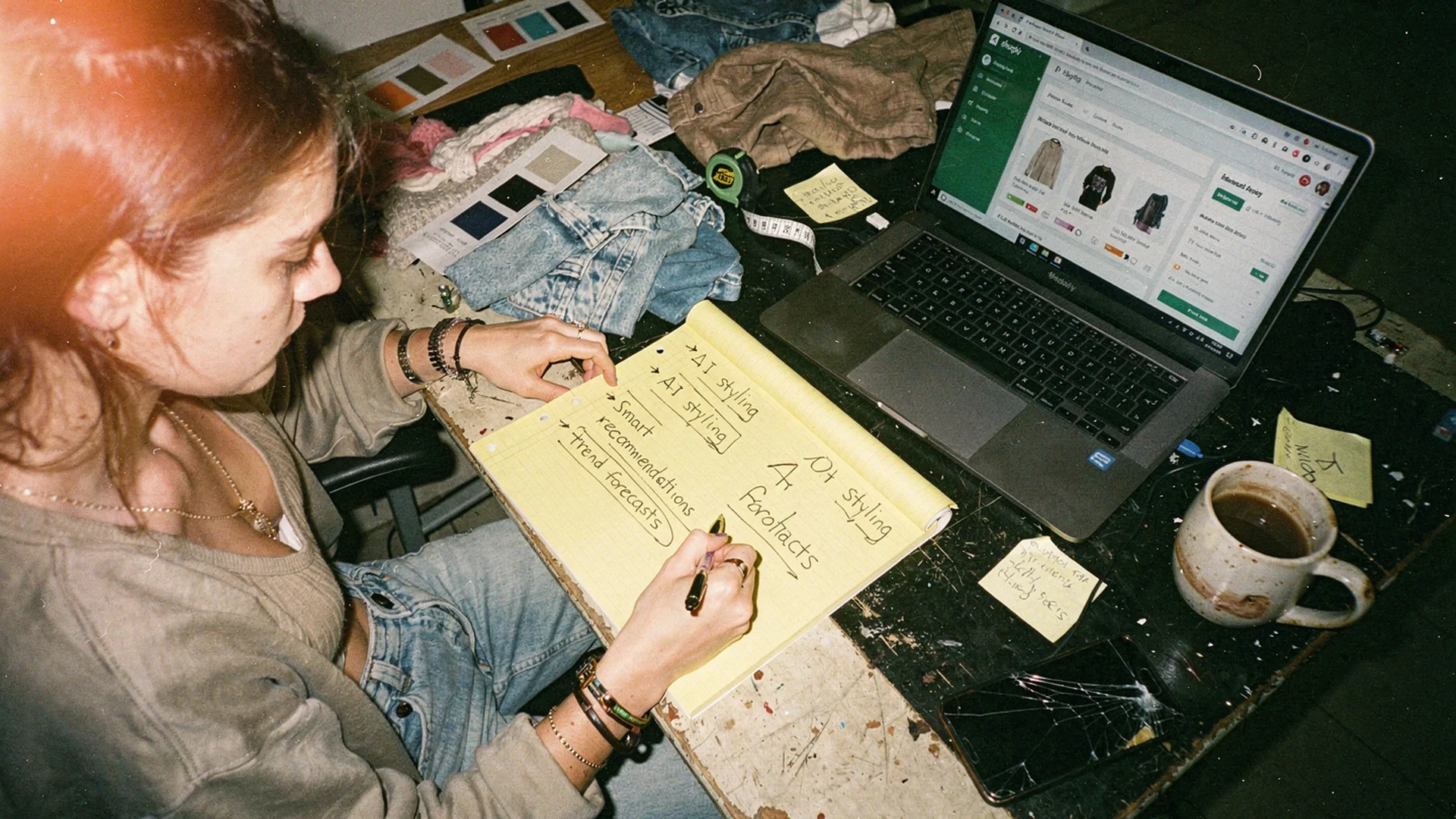
The merchants who win in 2026 treat AI as a fit and discovery layer, not a replacement for honest product pages.
Trend Map: Six Shifts That Survive Demo Season
Not every AI headline belongs on your roadmap. These six show up in merchant metrics, not only vendor slide decks.
| Trend | Shopper or ops job | Merchant signal | Deep guide |
|---|---|---|---|
| GEO and AI search citations | Get recommended in ChatGPT and Perplexity | Competitors cited, you are not | GEO for fashion |
| Intelligent product pages | Answer fit questions before checkout | PDP drop-off on hero SKUs | AI product pages |
| Visualization and try-on | Preview drape, length, coverage | Bracketing and fit returns | Cluster 05 hub |
| Styling assistants | Reduce “what goes with this” friction | Low AOV on single-SKU carts | AI styling assistants |
| Ops and demand AI | Allocate inventory by silhouette | Stockouts on winners, dead stock on losers | Cluster 06 forecasting spoke |
| Agentic support | Triage sizing tickets faster | Support tags cluster on rise and fabric | Cluster 06 support spoke |
Shopify’s returns overview continues to frame evaluation-layer clarity as margin defense, not novelty. For DTC apparel, margin defense usually means fewer preventable returns and clearer PDP truth.
GEO Is The Discovery Trend Merchants Underestimate
You can rank on Google and still be absent when a shopper asks an AI assistant which Shopify brand handles petite wide-leg denim honestly.
Generative engine optimization is how fashion brands structure pages so ChatGPT, Gemini, Perplexity, and Claude can cite accurate facts about fit, materials, and policies. Our cluster 04 guide on AI search visibility for fashion Shopify stores walks the implementation layer: extractable definitions, comparison tables, llms.txt maintenance, and monthly prompt testing.
Practical 2026 habit: run fifteen category prompts monthly, log who gets cited, patch the page the model should have quoted. Tools like Vizby help merchants audit AI rankings and maintain machine-readable catalog files without turning the blog into a tool brochure.
PDP Intelligence Beats Generic Copy Generation
The second durable trend is AI that makes product pages more specific, not more adjective-heavy.
For structured blazers, shoppers need shoulder line, torso length, button stance, and lining behavior. For satin midi skirts, they need hip ease, cling, and movement when walking. Generic drafts that invent stretch or length details increase returns.
The AI product pages spoke in this cluster covers teardown patterns. Pair that work with fashion product pages that convert before ads from cluster 04. Baymard’s apparel UX research still treats PDPs as decision systems; AI belongs when it increases clarity.
Visualization And Returns Economics
NRF and Happy Returns estimated $890 billion in 2024 retail returns. Apparel merchants feel that through fit mismatch, fabric surprise, and bracketing.
Visualization AI, especially virtual try-on on hero categories, attacks the return that never should have shipped. How virtual try-on reduces returns before checkout explains the expectation-gap logic. The cost of bracketing in online fashion shows why multi-size orders are a systems problem.
Antla virtual try-on is built exclusively for Shopify fashion brands. Across Antla stores, shoppers who engage with try-on average a 35% conversion lift when visualization was the main objection. Engagement rises to roughly 2-3x longer onsite on product pages where uncertainty blocked add-to-cart. Returns can fall by up to 30% when preview closes the gap before checkout.
Route comparison questions to the size recommendation vs try-on spoke in this cluster and the cluster 05 hub on best virtual try-on for Shopify fashion.
Styling Assistants And Adjacent Discovery
Styling assistants help shoppers combine items, respect dress codes, and build outfits from catalog constraints. They are not a replacement for merchandising taste, but they can lift AOV when single-SKU carts dominate.
The risk is recommending items your PDPs cannot support with fit truth. Launch styling layers after hero SKUs have honest photography, reviews, and where needed try-on. The styling assistant spoke in this cluster covers evaluation criteria in depth.
Tool Sprawl Versus Stack Discipline
The AI tools directory for Shopify fashion merchants in cluster 06 exists because merchants do not lack apps. They lack job ownership.
Add one AI capability per month, each tied to a metric: discovery citations, PDP conversion, support load, repeat purchase, stockouts, or return rate. The build an AI stack for your Shopify fashion store spoke sequences installs for lean teams.
Skip the pattern where five apps send overlapping messages while size charts stay two seasons stale. Start with why size charts fail on Shopify fashion stores when return tags say “wrong size.”
Persona Guide And Thought Leadership Spokes
Different operators need different entry points:
- Brand founders and lean teams: AI for fashion brands guide
- Tool shoppers: Fashion AI tools 2026
- Strategic planning: How AI is changing online fashion retail
Cluster 04’s online fashion store AI-era complete guide remains the launch-stage companion when you are still wiring photography, policies, and first collections.
Research Sources Worth Bookmarking
Google’s helpful content guidance applies to AI-era pages: people-first specificity beats filler. Product structured data helps Google and AI systems parse variants honestly.
Shopify’s conversion benchmarks remind you fashion lives or dies on trust signals. Evaluation-layer AI matters more than subject-line AI for many apparel brands when returns trace to fit, not discovery.
Merchant Action List For Q3 2026
- Baseline return reasons and PDP conversion on ten hero SKUs.
- Run fifteen AI search prompts; log citation gaps.
- Patch top PDPs missing fit facts models repeat wrong.
- Pilot one visualization or sizing tool on a high-bracket category.
- Link new guides back to this hub so internal traversal stays clear.
Frequently Asked Questions
What is AI in fashion ecommerce in 2026?
It is machine learning and generative systems applied to discovery, PDP evaluation, support, operations, and post-purchase service for apparel brands. The durable merchant trends are GEO visibility, intelligent product pages, visualization, and styling adjacency tied to measurable fit outcomes.
Which AI fashion trend should Shopify merchants prioritize first?
Prioritize the trend your metrics already name: GEO if AI assistants omit you, PDP intelligence if hero SKUs leak conversion, visualization if bracketing and fit returns dominate. Do not install a full stack before one layer proves ROI.
How does GEO relate to traditional SEO for fashion stores?
SEO earns rankings in Google results. GEO earns citations in AI answers. Both need helpful, specific pages. Fashion merchants should keep solid SEO fundamentals and add extractable definitions, FAQs, and honest comparison tables models can quote.
Does virtual try-on still matter with new AI copy tools?
Yes. Copy tools rarely show drape, length, or coverage on the shopper’s body. Try-on addresses the mirror question photography leaves open. Pair both layers on hero categories with high fit variance.
Where should I read about Shopify-specific AI tools?
Start with the cluster 06 AI tools hub and fashion AI tools 2026 guide in this cluster. Route fit visualization to cluster 05 and returns economics to cluster 03.
How often should fashion brands refresh AI trend assumptions?
Review quarterly at minimum. Run monthly AI prompt tests for discovery. Revisit tool stack when return mix or PDP conversion shifts on hero categories after a season change.
Nearby Antla Depth From Other Clusters
- Fashion returns reduction strategy on Shopify
- Shopify PDP conversion optimization for fashion
- Add virtual try-on to Shopify
About the author: Aaron is the founder of Antla. After years of frustrating returns, never looking like the supermodels on product pages, he set out to make fashion personal by helping shoppers see themselves in the outfits they want to buy. He mapped these trends so operators separate durable shifts from demo-season noise before they rewrite the whole stack.
Trend-spotting is easier than trend-testing. Start with one hero category, then explore Antla on Shopify when fit visualization is the gap your returns already name.